When I was eight, my third-grade teacher suspected that I had something wrong with my vision, and she was right. When I would read out loud, I would skip lines. And sometimes at the end of a long school day, the chalk board would get blurrier, like a gauzy veil was drawn over it. Mrs. Mathews was right: come to find out, one of my eyes had weaker muscles than the other. And so for a year I went to eye therapy.
I remember sitting in the waiting room for my appointments, reading old Highlights magazines. After reading all the stories with my new, extra-fragile glass bifocals, I would enjoy the pages filled with visual puzzles, like where you find lists of hidden images in a picture, or a line drawing where you saw a young woman looking over her shoulder, but if you turned the picture upside down suddenly you were looking at an old hag. Or if you looked at the positive space of a drawing you saw one image, but if you concentrated on the negative space you saw something else. Years later I marveled at how that doctor made sure we were working to strengthen our eyes and our perception even in the waiting room.
The eyes work by collecting and focusing light so that it can be interpreted by the brain.
But unless we have some idea what we are looking for, we will seldom find it, because our brains filter out a majority of the images our eyes take in so that we can make sense of what is in front of our eyes. Our brains perceive what is seen by interpreting, based on context, and by filtering out a great amount of input. We see this people who have had their sight restored either by surgery or by correction, or in studies of what newborns see. When asked what they see, they have no way of making sense of the light flooding their eyes. Of those who have the ability to talk, they describe brightness, and later flashes of color. Eventually, their minds learn to interpret the input coming through their eyes. There is even scriptural testimony to this phenomenon: in Mark 8, Jesus heals a blind man from Bethsaida, and after Jesus attempts the healing the first time and asks what the man sees, he says, “I see people, but they look like trees walking.”
In the reading from 2 Corinthians that we will hear this Sunday, we will hear Paul talk about the things that keep us from seeing the gospel as it really is. Paul points out that if we focus on the “god of this world,” we are unable to perceive to see God in unexpected places, or to see the gospel with clarity. Instead, our perception is “veiled.” Perhaps Paul is too generous to make the “god of this world” singular. Power, status, self-righteousness, money, material possessions, fame, greed, entertainment—all of these things we may worship, as we offer them the priority for our attention, our time, and our striving. There are so many gods we focus upon and elevate that we think will take the place in our hearts that belongs to God. One thing is certain: the gods of this world reign by being easily perceptible all around us, while many complain that they do not see signs of the true God anywhere. Once again, depends upon what you are looking for, and where you focus your attention.
As we prepare to enter into Lent, we are encouraged to expand our perception. We end the season after Epiphany each year with stories of transfiguration to give us the courage to allow our eyes to adjust to the seeing of who Jesus REALLY is in our lives, much like those disciples who witness his transfiguration in our gospel. Too often we seem to expect a bearded man, wearing a loose linen tunic, sandals, gorgeously-tressed hair. We fail to perceive him in other guises: the frazzled dad working three jobs to help put food on the table; the teenager hungry for someone to take her under their wing and counter the story she hears at home about being ugly inside and out; the neighbor with whom we have been feuding for so long we no longer remember why; the panhandler on the corner we sneer at for having a cell phone.
But the point of the transfiguration is not to focus on how Jesus has been changed. Rather, what if we looked upon him and realize that the veil has been pulled back: Jesus reveals just a tiny bit of who he really is, and once we perceive that, it is we who have been changed. In a year when even the everyday and commonplace has sometimes become a struggle, we may not perceive the ways in which the Christ-light has been revealed to us, much less within us.
The season of Epiphany is about drawing back the veil and joyfully encouraging us to see God’s presence everywhere and for everyone. Jesus’s transfiguration calls us to embrace our own, so that we ourselves may perceive that that same glory and light resides within each of us. As Jesus transfigures us, he urges us to leave behind the gods of this world. “Come, follow me. Be the light you need to see within the world.”
Every day, for years, he had sat just outside Jericho, on the road that led to Jerusalem. It was a good spot for begging. Especially when pilgrims came by on their way to the Temple to offer a sacrifice. He could hear the coins jingling in their purses—surely they could spare a coin or two for a blind man—especially if their consciences were laying heavy upon them.
Besides, sitting there, he overheard the news in bits and snatches from all over Judea. For a blind man, he stayed pretty well informed. Another rebellion by the zealots had been brutally put down by the Roman legions last month, and even he knew to scurry away when he heard the rhythmic tramping footsteps of a legion passing by—they were more likely to aim a kick at a beggar than offer any alms.
But it had been a long time since he had heard a crowd that big going past, all at once. Their accents were northern—could it be that they knew of that holy man named Jesus he had heard tell of, the one who could even bring the dead back to life?
He listened harder. Yes—he heard the name of Jesus several times. Two voices passed by, muttering about trying to get him alone to ask for places of honor again. Another three muttered that they were on their way to a certain death, and the fear and dismay in their voices was like a physical presence.
Bartimaeus heard a child exclaim, “I see him, Mama!” and quickly the beggar grabbed the child’s tunic for just a moment. “Is Jesus with you?” the beggar asked the child. “Yes!” the child exclaimed. “He’s come all the way from Galilee. We have followed him all this month.” The sound of a coin landed in Bartimaeus’s bowl.
“Bless you, child,” Bartimaeus murmured, and then he seized his opportunity. “Jesus! Son of David! Have mercy on me!!!!” he wailed.
“Quiet, old man!” hissed several voices around him. “The teacher has no time for you.”
But Bartimaeus would not be deterred. “Son of David, have mercy on me!”
And soon the sound of movement ceased. There was a whispered consultation off to the blind man’s right, and the sound of some disagreement. Then different voices loomed in the blind man’s ear: “Take heart, get up. He is calling you.”
Before the sentence was even complete, the blind man threw his cloak off his shoulders and hands guided him to where he just knew by some feeling that the teacher stood.
He wanted his sight. But more than that, he wanted to follow Jesus.
Even on his way to Jerusalem, human suffering encounters Jesus, and Jesus shows mercy and more than that, shows that he sees and loves us, as we grasp blindly toward faith.
In a way, we’ve seen much of this scene before. A few weeks ago, Jesus healed another blind man. And in our story today, just as with the little children, the disciples show themselves to still be world class bodyguards and “shushers,” telling Bartimaeus to be quiet. Nothing doing. Bartimaeus doubles down, probably getting louder and making even more of a commotion. And his determination pays off.
Who’s really blind here? And who is a true disciple of Jesus?
Those who have been with Jesus for weeks, months, and even years, STILL keep trying to get him to act in predictable ways, to put him in a neat little box. Yet here is this blind man, Bartimaeus. He confidently calls Jesus the “Son of David,” the longed-for Messiah. He confidently approaches the man he calls “My Teacher.”
What we see presented here is that Bartimeaus sees clearly who Jesus is and what his ministry means, even though he is a stranger, not a disciple, and is physically blind. Meanwhile, the disciples who have been alongside Jesus for these last 10 chapters have repeatedly shown themselves too afraid to see and recognize Jesus for who he is, much less accepting his predictions about his ultimate fate.
There is also an ironic twist in the middle of the story: “… They called to the blind man, saying to him, ‘Take heart; get up, he is calling you.” This is more than just guidance to a blind man. Instead, this is the language of a call narrative, just as God called to Moses out of the burning bush. Just as the boy Samuel heard a call in the night that even Eli, the prophet, could not hear.
Jesus is not just calling the blind man to come to him for a conversation; Jesus is calling to the blind man and to all of us to follow him as disciples who recognize and proclaim the Son of God Incarnate. Three times in that verse the word “call” appears. This is significant.
And Bartimaeus responds instantly.
Even though blind, he “springs up,” throwing off his cloak, and moves confidently, answering Jesus’s question with a bold declaration of Jesus as “My teacher….” The casting off of his cloak suggests the throwing off of his old life, the giving up of the possessions urged upon the rich man two weeks ago, and also has a faint echo of Elisha picking up the mantle of Elijah after Elijah is carried off bodily into heaven. A beggar’s cloak was their shelter, their blanket, their raincoat. Often it was all a beggar had. And Bartimaeus casts it aside like so much garbage in his eager faith to seize a new future, one of discipleship and hope.
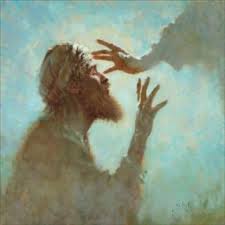
For the second time in two weeks, we hear Jesus respond, “What do you want me to do for you?” Last week we had James and John asking for preferential treatment and honor; this week we see a humble beggar, who sees with his heart and soul what the disciples cannot see despite long experience, asking for his vision to be healed. THIS is an appropriate request, and it is made in faith, which Jesus acknowledges in his response: “Go; your faith has made you well.”
Yet, Bartimaeus doesn’t “go.” He stays, and follows Jesus rather than returning home. Without a long, drawn-out production, without even touch, Jesus pronounces the blind man healed. Bartimaeus then demonstrates his faith again when, as soon as his sight is restored, he “followed [Jesus] on the way.” The Way of Jesus. The Way of Life. The Way of Love.
Bartimaeus is shown to be the archetype of a disciple, proclaiming Jesus as Savior without fear, boldly, courageously, even in the face of possible rejection; one who hears the call, and asks only for what will make him a better disciple, so that he may follow in the way of Jesus.
The healing of Bartimaeus is the bookend to the previous healing of the unnamed blind man two chapters ago. The differences in the two healings of blind men between chapters 8 and 10 is symbolic, and descriptive of the arc of the story that lies in between. The first blind man’s healing involved two steps, which resulted in partial healing and then full healing. Then for two chapters, Jesus sets out toward Jerusalem, and Mark has repeatedly emphasized the disciples’ spiritual and metaphorical blindness. They recognize Jesus as a teacher, but repeatedly stumble in gaining full understanding, perhaps because he starts telling them things they don’t want to hear about his coming suffering and death, even as he marches resolutely onto Jerusalem.

The difference between the disciples and Bartimaeus is that Bartimaeus knows he needs to be healed of what stands in the way of his discipleship. And isn’t it that way with us, too? Bartimaeus has the faith that he CAN be healed. Bartimaeus has true courage—and remember, the word “courage” comes from the French word for “heart.” Bartimaeus casts off his old life like a cloak, and courageously embraces his agency as a disciple and as a beloved child of God.
Can we take heart, and be courageous like Bartimaeus?
Jesus’s reminder about the power of faith in our own transformation are important. He reminds us that as humans, we have choices whether or not we want to ask for healing. All of us at one time or another feel our faith flicker, because it’s common to believe that we need no one but ourselves, to fall in with society’s dictum that we alone are responsible for our situations, to deny the role of grace in our lives, even when that is also heartbreaking. And then some of us have no awareness that there is anything within us that requires healing, even as we long for it without understanding or words.
What would it be like if we boldly responded to Jesus’s call to follow him in our own lives?
What if we believed in the power of faith against all cynicism, violence, oppression to heal the broken places within us, and within our world, that it could empower us to work real change?
How would our perception of the world change? How would our world, reeling from the mass murder in the synagogue yesterday, groaning under the cries of families fleeing torture and starvation and war, change?
Dare we go boldly toward a vision of the world in which true mercy and healing await our being brave enough and honest enough to admit that we both need it and want it? If we were willing to truly have faith enough in the healing power of love to help rid us of our fears and hatreds and suspicions, seeing everyone as they truly are—as beloved of God?
What if we ignored the voices that try to tell us we are too broken, the world too filled with jealousies and hatred, and instead embraced love, and the wholeness that faith and hope can bring?
What if we were brave enough to ask God to take away the blindness that preserves our illusions, that insulates and often entombs our hearts, and instead leaned into the faith that love, which is faith in action, really does heal?
May we have the faith to let Jesus in, to proclaim who he is boldly without fear; to open the eyes of our hearts; to have the courage of faith, the courage of love.
Take heart, get up.
He is calling you.
Amen.
Preached at the 505 on October 27, and the 8:00 and 10:15 Eucharists at St. Martin's Episcopal Church, Ellisville, MO.
Readings:
Job 42:1-6, 10-17
Psalm 34:1-8, 19-22
Hebrews 7:23-28
Mark 10:46-52
Blessed Savior,
we open our eyes to see your light,
and ask that it illumine our hearts
that we may serve you this day
with joy and gratitude.
Let our eyes be opened, Blessed Jesus,
where we once were blind,
to see your handiwork
throughout each moment
in our lives.
Let our eyes be opened, O Merciful One,
to see the broken and lost places
within ourselves and each other,
and through your grace,
to work for healing and reconciliation.
Let our eyes be opened, O Holy One,
that we may see with a spirit of mercy and compassion,
and be renewed to follow You
in hope and faith.
Lord Christ,
let your healing hand
rest tenderly
upon those
whose hope is in You,
especially those for whom we pray.
Amen.
(Photo--- "The Healing of the Blind Men" (Matthew 20:29-34) from an illuminated manuscript by Ilyas Basim Khuri Bazzi Rahib, 1684, located in the Walters Art Museum, Baltimore)