Showing posts with label Christmas. Show all posts

Tuesday, December 24, 2024

The Love That Lives Among Us: Sermon for Christmas, 2024


On a cold night in a field just south of Jerusalem, the wind blew among the rocks, and the stars sparked and spun overhead. Midnight, and little was heard over the wind whistling among the naked branches of shrubs, ruffling the woolen white clouds of sheep that dotted the landscape. The dim blue light that had lingered since the crimson sunset had long since subsided to indigo and then black. The three shepherds talked amongst themselves only to help stave off sleep, and boredom, and the whine of the wind.

Maybe that’s why they didn’t notice the wind suddenly stop. Suddenly, a star to the east flared brightly. The youngest shepherd saw it first, and grabbed his brother’s robe to get his attention and point his eyes toward the sight. There was just a few moments’ pause, and then-- it was if dawn had sliced the sky in two, and they were blinded as light poured down upon them, the stars vanishing instantly.

The eldest shepherd’s body seemed to hum and vibrate as a great wall of sound buffeted like a storm around them, vibrating like the string of the harp still slung over his back. The song that he heard was a new song, and the entire earth and sky around them seems to be joining in the harmony. They heard the thunderous booms and crashings of the sea, even though the sea was miles away to the east. The scrub grass and wildflowers that moments before had been shrugging against the wind now arrowed upward as if they were being tugged from the earth by an invisible hand. It was a song of indescribable beauty and also a physical weight against his shoulders, and his knees buckled. A flickering, dancing figure, even brighter than the brightness that had burst down, appeared before his dazed eyes, and sang to them, telling them not to be afraid.

Not be afraid? Of course, they were terrified, for who can look upon God and live?

But the Messenger repeated again her reassurance. She told the shepherds then that she bore good news of the birth of a child in a town nearby, Bethlehem. The Messenger told them what they would see there without ever actually telling them to go, and each word from her mouth was like a trumpet blast, yet sweeter than honey.

The one who was born would bear numerous names and titles: Wondrous Counselor, Mighty God, Everlasting Father, Prince of Peace. Peace, not like the peace that comes from silencing the oppressed, but a peace that comes from making no accommodation to injustice, peace that calls for acting with honor and integrity to bring justice and mercy to all.

While they were still taking all of that in, an entire throne of angels descended, singing glory to the Holy One, who had granted the shepherds favor and honor indeed. And the music poured over them like honey from the comb, and their rampaging hearts raced with wonder.

Then it was over. The angels and the choir receded back into heaven, and the darkness descended again, darker than dark as their eyes were still dazzled. Slowly, the stars winked back to life again. Almost shyly, the wind resumed its soft susurration among the rocks. The sheep grazed on.

The angelic choir still echoed in their ears, there among the rocks.

Yet peace like a warm cloak settled over them, and they knew the direction of the town and the direction of the star and the direction the Messenger had given them.

And so, they were drawn toward Bethlehem, to see a king in a cattle-stall; a messiah in a manger. They braced themselves for another great wave of light and music, but as they stepped down into the stall the star hovered over, there was no tidal wave of sound. There was no blinding flash of light. There was something infinitely more tender and precious, humble, dressed not in fine robes but wrapped lovingly in strips of rags.

And yet, something no less powerful poured over them as they beheld the young family and it intensified when the baby opened his eyes as dark as obsidian: the baby looked at them, and they felt their souls give a leap. In a stable in a tiny little town, they encountered Love in human form, delicate and new and yet ancient as the stones in the tower where they watched their sheep.

As the beasts of burden ranged around them and the holy family, they saw, breathed, and felt love. Love that lay in a manger to invite the entire world to gather in grace and gratitude and be fed with the very Word of God.

Tonight, we join them in witnessing saw Love in human form come down at Christmas, and the world has never been the same. At the sight of that small head and tuft of hair, they felt all fear and foreboding leave them. In its place, awe, wonder and joy lodged beneath their rib cages, and hope took root and began to grow.

With the birth of this little child, a new day was proclaimed—a day that drew together earth and sky, sea and land, and reminded us all that creation is a seamless whole. We are reminded that the power of God comes not in cataclysms or earthquakes but comes into our lives as a small helpless infant.

It is good that this is a story we tell and remember every year. It is good, because every time we hear this story, we get another chance to say yes, like Mary said yes and Joseph said yes and even those shepherds said yes to being drawn into the presence of God’s love in human form.

May we all be drawn there, too. Drawn toward the Love that turned and slept in his mother’s arms. Love that offers us everything and demands from us everything in return. Love that stands against principalities and powers.

Love that moves among us still, and calls us home, not only for ourselves, but to work to become home that reflects the Beloved Community Jesus was sent to gather in his life and death, and embody in his resurrection. For those of us who claim the name of Christ, we are called to follow those shepherds to go, to see, and to walk away transformed into a haven and a refuge for all those who stand in darkness and hunger for a light of which they’ve only dreamed. A love which declares everyone and everything beloved and set apart consecrated to leading others to light not through fear or division, but through belonging and radical welcome. A love that seeks to live among us, tonight and every night. 

Amen.

Preached at the Christmas Eve and Christmas Day services at St. Martin's Episcopal Church, Ellisville, MO, December 24-25, 2025.


Readings:

Sunday, December 24, 2023

God With Us-- Sermon for the Eve of Christ's Nativity, December 24, 2023


Once, we knew we lived, and walked, with God.

In the beginning God placed us in a beautiful garden
(1)—an orderly place, where everything had a name, and everything had a purpose, and everything, even the humans, had been placed there in this beautiful garden by God. We knew we lived with God because every day God would come and walk in the cool of the evening with us. (2) 

We’d stroll along, companionably, and talk about our day together. God would ask us what we had done: “Today we found a new plant over in the verge over there, and we were drawn to it by its amazing fragrance. Few flowers smelled anything like this plant, God, so we named it fuschia.” And our days were filled with wonder, and everything we saw and tasted and touched was a miracle. And God was very pleased. 

When we asked God what God had done that day, God would talk about very important matters, something like midwifing a new solar system in another galaxy,
(3) or watching puffins play, or teaching chimpanzees how to use a stick to dig termites out of their mounds so they could eat them as a tasty treat. And always making sure to be home in time for our shared evening walk.

But our restless selves were not satisfied, and so we chose to move away from God and God’s loving companionship. We chafed to be independent. We chafed to make our own rules.
(4) That garden and that companionship was tossed aside. (5) 

But God has been chasing after us ever since.

And when we are very honest with ourselves, we have felt something missing deep inside us.

We built monuments to ourselves in Babel, in Nineveh, in Athens, in Mesopotamia, pretending we didn’t need God. God kept visiting our ancestors all along the way, and maybe we’d walk beside God for a while, but always, always, we would decide we could choose our paths better, find an easier way. God even rescued us from slavery in Pharaoh’s courts, parting the waters of the sea like they’d been cracked open like an eggshell, but even then we complained and carped.
(6) 

Out in the wilderness, where everything was as un-gardenlike as possible, where hunger and thirst and rattlesnakes dogged our every step, we grudgingly agreed to not only follow God’s cloud in the day and fire in the night and eat the food of angels and the fried chicken God rained down on the ground.(7) 

And in return, in order to keep us happy and safe, we agreed to follow God’s 10 Simple Rules—all of which boiled down to one word really: Love. Love of God and love of each other.(8)

We’d promise—and it would last for a little while. But then, like the trickster raven, we’d get distracted by something bright and shiny, or we’d want to be like the other scrabbling clans around us, or we’d decide we didn’t need a God so incredibly close to us, and we’d push God away and wander off again to do our own thing. Over and over.
(9)

When we did turn to God, all God asked was to love us and have us love God and love each other and have some faith. All God asked for was for us to honor God’s presence in the midst of us—not for us a God who needed mountains like the Greeks or Ziggurats like the Babylonians or Teocalli like the Aztecs. All God wanted was to live in the midst of us, and for us to love God and each other. Really.

But we wanted control. We kept trying to put God in a box. David tried to build God a house of cedar, and his son Solomon actually achieved it. God said, "No, no, I’m happy living among you all, a tent is fine, really!"(10) 
But we wanted our God to be just as awe-inpiring as the neighbors’ gods. 

Each generation made that house bigger and bigger and bigger, and added porches and courtyards and antechambers dripping in gold and gemstones and ivory, all obscuring the fact that they thought they were further confining God out of their everyday lives. Soon, talking to God was reserved for only special days for a select few, and the rest of the time they could go about their business without even thinking about God shut behind those imposing walls and turrets.

But God would not be shut in a box. Not then. Not ever. God would not only be willing to be brought out like the fine china on special occasions or like a lucky rabbit’s foot when things got tough. Because here was the secret: even when we shut our eyes, even when we pushed God away, God was still there. Not forcing us, but waiting for us to see and trust in God.

See, God is always with us, loving us—even when we turn our heads, or our hearts, and insist on our own way—even when our own way is out there with the rattlesnakes and the desert wastes of our fearful hearts even when our own way looks more like a hell of our making. God comes to show us that love is justice and mercy in action—and calls us to embody that with joy and faith. So simple, yet so difficult.

And so it went on. God calling to us, setting before us God’s beautiful vision for which God had made us—and us resisting, mistaking selfishness for security and wealth and power for well-being. Which never worked, much as we wouldn’t admit it.

Finally, God decided that prophets and saints and sages and mystics and even angels just weren’t enough to get us to remember those days when we knew God was always with us.

God with us…..

That gave God an idea.

God, who is the literal embodiment of love and community, decided to actually become one of us. And not as some fire-bolt throwing, six-pack flaunting, bearded Titan; not as some pampered princeling with a fine pedigree and a fancy mansion. Oh no. God had had enough of boxes, even fancy ones. God wanted to show us that God is always loving and present to us—even in the least significant places.

God came to be one of us—and one of the least of us, because God had been trying to tell us all along that money, fame, political power, military might, and oppressing others in the name of our comfort were no way to fill the aching empty spaces in our hearts.

God came to us as the most helpless creature in the world—a human infant, born to a teenaged mother in an occupied territory under the thumb of one of the greatest empires the world has ever know. God came as a little child, to show us the qualities that really matter by embodying them:

Compassion for the lost and aching.
Healing for the hurting.
Wisdom and teaching.
Food for the hungry, given freely.
Empathy for the wayward.
Freedom for the oppressed.
Community and equality for all.
Self-sacrifice and virtue for everyone’s mutual benefit. Especially the forgotten.

A little child, wrapped in rags, lying in a manger—a feeding trough. He and his family looking, like all of us, for a home. Born TO us, born FOR us, living and teaching and loving among us.

Tonight, tonight, if we are very quiet, we can hear—if we are very still and intent—the slight rasp of angel wings as they flutter overhead just as they did to those ragged shepherds all those years ago, and we hear that promise, as much a promise as a plea:

Do not be afraid.
To you, and me, and to all of us is born this day a savior.
He will be called Emmanuel—God With Us.
He will be a Wonderful Counselor, Mighty God, Prince of Peace.

He will come to live among us, to walk alongside us, in every moment of our lives, no matter how much we try to shove him back in a box and only bring him out on Sundays.

No, our Savior is looking for a home. May we open the doors of our hearts, and spirits, and invite him in, that he may guide us in learning how to live a life of purpose, of joy and connection and life eternal, grounded in love. Jesus didn’t come to reward us for when we die. Jesus came to show us how to live. And it starts by remembering how to walk alongside him, allowing him to show us the way of virtue and love, every day of our lives.

Joy to the world! Jesus Christ is born this night. All he asks is that we live among him, and allow him to a home inside our hearts, that we may walk beside him. Tonight, and every night. God with us. Emmanuel.


Preached at the 8:00 pm Christmas Eve Choral Eucharist at St. Martin's Episcopal Church, Ellisville, MO.

Readings:

Citations:
(3) Job 9:7-10 


Saturday, December 24, 2022

Where Love Is, There is God: Sermon for the Eve of the Nativity, Dec. 24, 2022


That gospel story we just heard cannot be surpassed. In it we have faithfulness, tenderness, awe, wonder, probably a little fear, relief, praise and joy. Through the shepherd’s example, we are encouraged to reach out to God through our God-given imaginations and not be afraid to believe the impossible. We are called to care, fidelity, and compassion, as Joseph modeled, and we are called to giving ourselves over to God in the pursuit of bringing about God’s kingdom, boldly, as Mary modelled. One thing that the shepherds, Joseph, and Mary all knew was that love had come among them, and their lives would be forever changed.

That’s it. The message of the most beautiful story in the world: where we act to bring love and warmth into the world, we encounter God.

It’s the part we don’t hear tonight that we spend our entire lives tracking down. The part that tells us “How”—how to welcome Jesus into our lives, and show that he still lives by our own witness, just like those shepherds in our gospel. How to receive Jesus not simply by saying we believe in him, but actually shaping our lives by his example.

And so, alongside the beautiful story we just heard, and that we will celebrate for these next many days, I want to offer you another story. Some of you may have read it in a book of stories by the great Russian master Leo Tolstoy. The problem is, he read it somewhere, attributed to an anonymous author, and he adapted it, thinking it was a folk tale. By the time he found out the true author, his works had already entered the public domain. So tonight, I want to share with you a version of the original story, written by a French pastor named Ruben Saillens. Even better, let me introduce to you the main character, because his name, so perfect for our congregation, was “Father Martin.”(1)

One hundred and fifty years ago, in the French city of Marseilles, there was a humble cobbler named Martin. Although he was an incredible shoe maker, his generosity and humility led him to live a simple life-- he had his tiny shop on a dusty side street consisting of a single room, and above it he lived in our studio apartment that was neat but plain. Father Martin's wife had died many years before, and their only son had been a sailor who had been lost at sea. He had a daughter, too, but for some reason they no longer spoke, and when asked about her, a single tear would leak out of his eye and run down his cheek as he shook his head mournfully. Yet even though he had known these tragedies, he was nonetheless known as a simple, kind, compassionate man.

It is Christmas Eve, and there's a sharp chill in the air as Father Martin closes his shop for the day.

He heads upstairs to his apartment, lights a stove, prepares a simple meal of stew and bread. He takes his cup of wine and goes and sits in a tattered armchair after pulling out the well-worn Bible from his shelf. He turns to the gospel of Luke, and reads about the struggle of the Holy Family to find a place to rest as they awaited the birth of Jesus. “There was no place for them in the inn,” he reads, and traces his fingers along under the words. “No place for Jesus—no place for the savior!” he exclaims in empathy.

He looks around his tiny home, noting that things may have been worn and well used, but they were neat and clean--certainly much better than spending the night out on the streets, or in a drafty barn. Father Martin thought slowly, “Oh that I could have made room for him here! I would have been glad to see him, to shelter him, and to welcome him into my home.”


“Of course,” he continued, “I have no gifts-- certainly not like the gold and the frankincense and the myrrh that the Magi brought. But what did the shepherds bring? It doesn't say-- but perhaps they didn't have time to get anything. Perhaps they only brought themselves.” Father Martin suddenly looked up on the top of one of the shelves along the wall and saw a small tattered cardboard box he sprung across the room and got it down and looked inside, where two perfect little shoes lay wrapped in tissue paper, made for a baby long ago whose parents had never come to get them. They were the best thing Father Martin had ever made-- his masterpiece. He smiled and touched the supple leather and neat stitches. “This is what I would give to Jesus--my very best pair of shoes I ever made! Oh, I wish I could have seen him and his family!”

He smiled for a moment at his own foolishness. The old man closed the box carefully and returned it to its place on the shelf. He then walked across the room and sat back down in his chair, sighing. Soon his head nodded on his chest, and he fell asleep. His lone candle burned itself out.

A voice suddenly spoke out of the darkness. “Martin!” “Who's there?” he cried out, seeing no one. But the voice, continued gently, “Martin, you wanted to see me. Keep an eye out on the street for me tomorrow.” And then the voice ceased. Martin rubbed his eyes wearily, and heard the clock strike midnight. It was now officially Christmas Day. Surely he must have been dreaming. So he put on his night clothes and crawled into his bed and fell asleep.

The next morning when Martin awoke, he was convinced that he had heard the voice of Jesus. Surely he had nothing to lose by remaining watchful as the voice had told him and seeing if he could see Jesus walking on the streets outside his shop. surely he would recognize Jesus as Jesus passed by-- after all, hadn't he admired paintings of Jesus throughout his entire life? And so he dressed, went downstairs to his shop on the main floor, and pulled up his chair at the large front window.

It was barely dawn, and there was no one on the streets. All that Martin saw was a street sweeper working in the bitter cold. He shivered visibly as he tried to attend to his work, rubbing his hands together, and stamping his feet to keep the blood circulating. Martin, thought, while he was waiting to see Jesus, surely he could take time to offer the man something warm to drink. So Father Martin opened the door and called out to the man. “Come in, won't you? Come in and let me offer you something warm to drink and a seat by my stove if only for a moment!”

The streetsweeper turned to Martin gratefully, and came in from the cold, scraping his boots on the mat outside first. “I can only stay a moment,” the man said. “I don't want to lose my job.”

“Let me make you a cup of coffee, at least. Surely you have time for that!” exclaimed Martin, and the streetsweeper couldn’t say no. Yet even as he prepared the pot of coffee, Martin's eyes kept darting to the window to the street outside to see if anyone was passing.

“Why are you looking outside so often?” asked the street sweeper.

“I am waiting for my Master,” Martin replied.

“Your Master?” the street sweeper asked. “I thought you owned this shop.”

“Yes, I do, I was talking of another Master,” Martin replied.

“Ah, sure,” said the street sweeper, too tired to try to solve riddles. He finished his cup of coffee, wiggled his toes in his boots, and prepared to leave. “Well, good luck, I hope you see your Master today.”

The door closed behind the street sweeper, and Martin sat down again, watching the street closely. A group of children passed by, singing Christmas carols. Martin waved, and they waved back. But still no Jesus. Some people saw Martin watching from the window—he smiled invitingly, and even those who had seemed less than happy smiled back. But still no Jesus.

Martin made a simple lunch from some of his leftover stew, and sat watching carefully. But still no Jesus. A few beggars were made brave by Martin’s smile, and approached, begging for a few pennies. They were not disappointed, and left with enough to buy a small roll and some cheese. There were cheeses-- but still no Jesus.

As darkness approached, the streets grew emptier and emptier. A small, ragged brown mutt slunk by sniffing in the gutter for scraps, limping slightly. The butcher down the street acted as if he would strike the pup with his broom, and the dog yipped in alarm and scurried straight toward Martin’s door and leaned against the post. Martin reached into the stewpot and pulled out a few pieces of meat and some of the broth, putting them on a chipped plate. He took them out to the poor dog, who, after starting, carefully approached the plate in almost human disbelief. Within moments the plate was licked clean, and the dog allowed his head to be petted before he trotted off.


The streets were in twilight and empty now. Suddenly around the corner a figure appeared, and Martin’s heart leapt—but it was only a young woman, not much more than a girl really. She held a bundle in her arms, and as she got closer, Martin could see she was dressed in a threadbare smock and a ratty coat, and the bundle was an infant, about nine months old. Martin sprang outside when he saw her stagger. “Ma belle!” he called out as he rushed to her as she leaned against the wall. When he was closer he could see that her face was creased in weariness, and the baby clung to her for warmth.

“Why, you don’t look well, ma chere. Why are you out so late on such a cold night—and alone with a little one?” Martin asked.

“I’m ill, and going to the hospital, and hoping that they will have pity and admit me although it’s Christmas Eve. My husband is away at sea, and should have returned. But it’s been three months. And now I’m ill…” The shoemaker immediately though of his own son, and his heart ached.


“Please, won’t you come inside for just a moment and warm up a bit? I have some stew, and milk for the baby.” He looked so kindly she felt reassured, and she followed him inside. Martin insisted on taking the baby from her so she could eat, and found one of his wife’s old shawls he had kept for sentimental reasons and draped it around her shoulders, all while crooning to the baby. When the young woman finished eating, he poured out some milk in a cup for the baby and placed it in ront of her so she could feed the child. As he passed the baby over, the blanket slipped, and he saw that the baby’s feet were bare and cold.

“No shoes? Oh no this will never do,” Martin murmured out loud. He looked closer. Could it be that the size was right? He went over to the shelf and pulled down his masterpiece shoes, and took them from the box and unwrapped the paper. Ah, they were the best shoes he had ever made! But he had no use for them, really—shoes are made to be worn, not stored away. And so Martin came to the woman, holding out the shoes, and asked “Will you allow me?”

“I have no money to pay you,” she cried, “and those are so very fine! They are fit for a prince!”

Martin smiled, “We have your young prince here now. Let’s try them on.” And the shoes fit as it they were made for the baby’s feet. It seemed impossible but they looked even more beautiful actually being worn. The young woman clasped the old man’s hands in gratitude and got up.

“I must go,” she said. “You have been so incredibly kind! I can never repay you.”

“No need, my daughter. Just get yourself well, and I will pray for your husband to be home soon!” The door shut behind her, Martin sat down again thoughtfully. It was now night. A fog even began to roll in from the sea. No point in watching any more. Jesus had not come!

He was so heartbroken he moved to his chair and slumped down. It all must have been just a dream! “He didn’t come!” he repeated over and over to himself.

Suddenly the room filled with light. The door of his shop swung open, and he saw all the people he had seen that day—the street sweeper, the passersby, the carolers, the beggars, the young woman and the baby. Each one approached Martin and said, “Didn’t you see me?” Over and over again. Martin was astounded, and his mouth formed a small o in wonder and shock. Could it be?

And then, with one voice, they spoke in the voice Martin had heard the night before:

“I was cold and you warmed me. I was hungry and you fed me. I was thirsty and you gave me something to drink. I was a stranger and you invited me in. I was naked and you clothed me.”2)

Martin suddenly understood. Jesus had come, after all.

And so Jesus has come among us, too, and comes to us still, in all those whom we can welcome and help not just in the Christmas season, but all year through. Jesus has come, and lives among us—in the room that we make for him in our hearts and in the love that we share with those we meet, Where Love is, there is God. That’s the message of Christmas.

Amen.


Readings:


Citations:
1) Ruben Saillens, “Where Love Is, There is God,” translated from the French by Bob Goodenough, found at his blog Flatlander Faith, from the post “Papa Panov should be Father Martin,” November 20, 2018. The story by Tolstoy is known as “Papa Panov’s Special Christmas,” which can be found here.
2) See Matthew 25:35-36.


Thursday, December 22, 2022

At the Gate of Advent: Speaking to the Soul, December 22, 2022


Mary is waiting, 
   every new ache
      ironically raising a stir of hope.
Joseph is waiting,
   wide awake
      to keep those crazy dreams at bay.
The angels are waiting
   and warming up their voices for the cantata,
   the altos humming a perfect fifth
      below the melody.
The shepherds
   don’t yet know they are waiting,
      but they are, eyes darting unconsciously skyward.
The sheep and goats are waiting,
   grazing while they wait,
      in the eternal wisdom of sheep and goats.
The goats are waiting
   to see if they get written out of the tale
   at the end.
The sheepdogs are waiting
   baring their teeth at malevolent shadows
   that blink with yellowy eyes
   and slink away.

The manger
   -temporarily still just a manger,
   corncrib, not crib-
      is empty but ready for the spotlight.
Zechariah and Elizabeth
   are up all night with a three-month-old
   nicknamed “Jumping Jack,”
   smelling of curdled milk and damp nappies,
   but they are waiting too.
The Magi are scrutinizing the star-charts,
   arguing, debating, pointing furiously,
      and redoing the math to no avail,
      subconsciously preparing a shopping list
         because the signs have spoken.
The Star is waiting, flaring on cue,
   testifying to portents and prophecies
   saying all that is needed
   simply by being itself.
God rubs her hands together in anticipation,
   like all parents
   when they know they have found
   the perfect gift.

So we wait too,
   on this longest night.
And while we wait, let us
   stand in awe at the vault of stars,
      who serve as witness and stage for wonders;
   breathe in stillness and alertness in this present moment
   offer up simple gratitude for the gift of hope
   sing along with celestial concerts
   practice peace for the Prince of Peace
in gratitude that God came to dwell
   among us
   as one of us
making the Creator human
and the created holy
infusing divine love into finite flesh
that we might dance with God
and truly love one another.


This was first published at Episcopal Journal and Cafe's Speaking to the Soul on December 22, 2022.

Wednesday, February 2, 2022

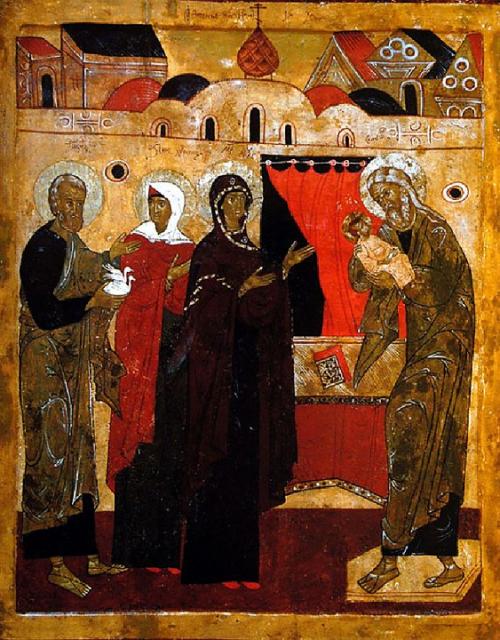
Prayer 3292: For the Feast of Candlemas


(Feast of the Presentation of Jesus- Luke 2:22-40)

Most Blessed Savior,
may we praise you in the temple and in the streets,
extolling your many blessings boldly
and witnessing to your abiding loving-kindness
in all we do and say this day.

Make us strong in your wisdom, O God;
let us grow in heart and mind,
sinking deep roots
into the verdant ground of your commandments
loving You and our neighbors
as You love us.
May our own countenance
shine forth with the Light of God's Wisdom,
and with the radiance of your Incarnate Word.

At eventide, let us depart in peace,
having served you humbly, atiently, and with charity,
having looked with eyes of love upon the world,
and knowing that we have seen the Savior
in each face we have encountered.

Keep us all this good day,
and bring us to our rest in safety and assurance,
and pour out your blessing
on those for whom we pray.

Amen.

Saturday, December 25, 2021

The Reason for the Season: Sermon for Christmas Day


Welcome to the First Day of Christmas.

Just saying that is in some ways a countercultural declaration. But it’s true—much of the world around us believes that Christmas is over, even before the trashmen have picked up the discarded packaging from all the present from the curb and carried them off to a landfill. Stores are preparing for post-Christmas sales with deep discounts. Already, right now, people who just spent weeks putting up their tree and lighting up their house brighter than the alien spaceship from Close Encounters of the Third Kind will begin tearing everything down and boxing everything up before the Ghost of Thanksgiving turkey has even been made into turkey tetrazzini. The creches will be deconstructed faster than a traveling circus leaving town one step ahead of the law.

That’s why I give thanks that we belong to a tradition that insists that Christmas is a season. That insists that Christmas is just beginning. And even, if you will bear with me, suggests that Christmas lasts year-round.

It’s even right there in between the lines in our gospel – right after Mary was left pondering and the shepherds departed to rejoice and praise God and count how many sheep might have wandered off or gotten their horns stuck in a bramble bush in their absence.

It doesn’t make it into the lectionary, but Mary and Joseph and that little baby were still there. And that baby still needed to be tended, and fed, and burped, and changed, and swaddled, and rocked. Mary and Joseph don’t even know the Magi are on the way. But Jesus still needs tending, still needs to be cared for and adored and kept warm.

And that’s an important reminder for all of us. If we think that Christmas is just one day, we lose sight of the reason for the season.

No, Christmas is more than one day. It’s more than 12 days, despite what the song—and the liturgical calendar says. And Christmas is the celebration of the coming into the world of the One whom we call Wonderful Counselor, Our Savior and Redeemer,-- but, especially, we call him Love Incarnate “Love Came Down at Christmas,” or so claims the classic Christmas carol.

But love is meant to STAY at Christmas—and even beyond Christmas.

Sometimes we can get too busy in the hubbub of the season to remember that. We can get distracted wanting the shiny things, wanting everything to be perfect, putting all this pressure on ONE single day—one and a half days if you include Christmas eve night—that we forget what Christmas is all about.

Christmas is about love. Love not just for family and friends, but love as a companion and as a practice. Love as a way of life. Love, meant to show us the way to truly praise and give thanks to God for all our blessings. Love as worship and as testimony to who God is for all the world.

We often say Christmas lasts 12 days. But what do we do on day 13 to make Christmas a feast EVERY day?

I saw this meme on Facebook as I was posting a prayer the other day that suggests an answer, and it moved me. I added a few tweaks, but I wanted to share it with you. It’s a spin-off on 1stCorinthians 13.

I call it First Christmas-ians 13.

If I decorate my house perfectly with plaid bows, strands of twinkling lights and shiny balls,
but do not show love to my family and my neighbors,
I am just another decorator.

If I slave away in the kitchen, baking dozens of Christmas cookies,
preparing gourmet meals and arranging a beautifully adorned table at meal time,
but do not show love to my family and my neighbors,
I'm just another cook.

If I sit down at a magnificent table without thankfulness and love,
or forget the hungry in our midst,
I have forgotten the reason for the season.

If I have remembered to buy all the batteries of every kind,
including the rechargeable ones plugged in,
but forget to love,
I have no power.

If I work at a soup kitchen,
carol in the nursing home,
and give all that I have to charity,
but do not show love to my family and my neighbors,
it profits me nothing.

If I trim the tree with shimmering angels and crocheted snowflakes,
attend a myriad of holiday parties,
and sing in the choir's cantata,
but do not focus on those I love the most
and those who are or feel unloved in the world,
I have missed the point.


In other words…

Love sets the decorating aside to kiss the spouse or buy the hungry a meal.
Love is kind, though harried and tired.
Love awards points for effort when the heart is in the right place.
Love is thankful rather than grasping for more.
Love is patient when things go wrong, especially at Christmas.
Love recognizes and is present with those for whom Christmas is hard.
Love stops the cooking to hug a child or call an elderly friend.

Love recognizes that for some people,
Christmas is not a day off from work.

Love doesn't envy another’s home
   that has coordinated Christmas china and table linens
   or Christmas lights that can be seen from space.

Love doesn't yell at the kids to get out of the way or be silent,
   or expect them only to attend the children’s service,
   but is thankful that they are there to be in the way,
   for they represent life and hope and joy in their purest forms.
Love sees the face of Baby Jesus in every child,
   no matter how fussy, wet, hungry, hangry, or overtired.

Love admires the dad in flour-smeared jeans
   frantically assembling a present at three in the morning
   as much as if he were Anderson Cooper
   hosting the Christmas parade on TV
   in a Ralph Lauren Purple Label suit.
Love lets the Mom with the wailing toddler 
   trying to grab all the candy
   cut in front in the checkout line at the grocery store
   and tells her she is a rock star.

Love doesn't give only to those who are able to give in return,
   but rejoices in giving to those who can't.
Love doesn’t judge when it could hug.
Love wears a face mask around strangers
  and is willing to sacrifice comfort to prevent others becoming ill.

Love bears all things (except grudges),
believes all things,
hopes all things,
endures all things.
Love never fails.

Tinder-dry trees will fill the landfill,
video games will break,
single earrings will be lost,
big screen TVs will become obsolete,
leftovers will turn to green furry goo in the back of the fridge.

But the gift of love will endure--
and will endure the whole year ‘round.


Welcome Jesus. Welcome Christmas.

Let us live out our love always and every day, and let us share that love with each other, and the world.

Amen.

Preached at the 10:30 am Christmas Day Eucharist at St. Martin's Episcopal Church, Ellisville MO.

Readings:


Friday, December 24, 2021

The Christmas Heart: Sermon for Christmas Eve


People always want to quibble.

They want to point out that so many things the gospel writers, even Luke, who claims in the first 4 verses of his gospel, he is writing “an orderly account” so that his audience “may know the certainty of the things you have been taught.” And see, already, I have said something to quibble over, because the person writing probably was NOT named Luke, and may not have been the “Luke the Physician” who was a sometime companion to Paul, and may not even have been male.

Then there’s the argument over the dates—Jesus’s couldn’t have been born as late as 6 CE, and yet THAT is when Quirinius, the Roman governor of Syria, which included Israel, ordered a census. And the census didn’t require you to travel, because it was for purposes of taxation, and you KNOW the taxman always wants to know where you live to determine the tax you will pay. UNLESS, of course, Joseph owned property in the city of Bethlehem itself. Then he might have travelled to claim the city as his home, because the Romans reduced the taxes of urban dwellers up to 50%. And THAT possibility, my friends, shows just how much like all of us Joseph was—trying to get his tax bill reduced by hook or by crook. And by the way—there’s still five business days to get those last donations in the St. Martin’s so that you can take them off of this year’s taxes—don’t delay!

And then there’s the debate about the virgin birth (the word for virgin actually meant unmarried young woman). There’s even a charge that having shepherds come to the place where Jesus was born is meant to echo the births of great heroes in Roman legend, like Romulus, Oedipus, and Paris—to place Jesus alongside great, legendary leaders, despite the humble circumstances of his family, including his membership in a race of people who had been subjugated by Rome.

This is what happens when you let your head get in the way of hope. It keeps you stumbling in the darkness of hopelessness, as our reading from Isaiah reminded us from its very first words.

And it’s at this point that we have to ask ourselves what happens to people who let their heads throw up roadblocks to truths that they find uncomfortable—either uncomfortable because they are potentially bad, but also uncomfortable because they sound too good to be true. That’s a kind of uncomfortable truth, too. Just that phrase “too good to be true” smacks of past disappointments. No one, after all, wants to appear gullible, or naïve. No one wants to play the fool. So we close our hearts.

In our gospel today, the most amazing good news gets proclaimed in the most amazing ways. I mean, look at this cast of characters: emperors and potentates and angels and heavenly hosts! And look at the scenes: the bright lights of Bethlehem, hillsides shrouded in darkness, the dark skies being rent apart by blazes of iridescent light and the songs of angels more deafening and surreal than anything one would expect-- and I've been to a Journey concert. And look at all the traveling that takes place: from Joseph and Mary shlepping from Galilee to Bethlehem, and let me tell you, heavily pregnant women don’t even want to travel to the bathroom until they have to. Then there’s the angel descending from heaven to drop heavy pronouncements on the heads of stunned and frightened shepherds, shepherds who fight off lions, leopards, and jackals for a living, and so were not exactly prone to terror.

Disbelief, scoffing, delusion-- these are things that come from giving your head a lock over your heart. And if any of the main characters in our gospel today had led with their heads instead of their hearts, we would not be gathered here today. And let’s give our own hearts some credit for the fact that we ARE here, together, today.

What I am talking about goes beyond the calculations that have led some people to declare that they have a relationship with Jesus—those calculations, I mean, that runs along the lines of a wager, that goes something like this: “when I die, I don’t want to go to hell; to escape hell the preacher has said I have to say I believe in Jesus; therefore I will say I believe in Jesus to escape hell.” That’s one sad, fear-filled line of thinking, right there—death is never a good starting point for anything.

Jesus comes to us as an infant to remind us of that. Jesus does not become a vulnerable human baby to scare us about how we are going to die. Jesus becomes a vulnerable human baby to tell us and to SHOW us how to live—how to live a life full of wonder, full of hope, full of generosity, full of joy. Full of heart.

An open heart is a sign of bravery. After all, an open heart is, by definition, a vulnerable heart. It’s not irrational—after all, it ponders and wonders. But it starts from a point of generosity rather than fear or calculations of possible cost.

Maintaining an open heart is also one of the most dangerous and revolutionary stances you can take—and let us never forget that Jesus was a revolutionary, raised by his revolutionary mother Mary (and if you don’t believe me, listen to that Magnificat again carefully). Jesus wasn’t raised by a mother who said “Hm, let me think that over and get back to you” while she set up the mental abacus. Instead, he was raised by a mother who led with her heart, and who had the courage of ten strong men. She had courage, BECAUSE she had heart, and because she led with that heart when told she would do what seemed like impossible things.

There it is: right there after the shepherds have left most of their flock behind with a skeleton crew, after they’ve rushed into town and barged in on an exhausted couple with a fussy baby, barged in even without a casserole, even though they are complete strangers because they just have to see for themselves. And once they see for themselves, and then gotten finished unspooling their tale, what reaction do they get?

The gospel does not record or mention either Mary or Joseph responding verbally in any way to the story these strangers tell them—the same one the angel had told Mary, the same one Joseph had heard in his dream, What we hear as a response is this:

“Mary treasured all these words and stored them in her heart.”

Another translator put it this way: “Mary stored up all these things, trying in her heart to penetrate their significance.” Mary’s reaction does not come from her head but from her heart. Think about that. Then examine the possible truth and relatability of this statement in your own lives.

Where do you store the things most precious to you—the most precious memories of your past—the smells, sounds, taste and feel of a beautiful day, or a loved one’s laughter or caress or hand at the small of your back? Do you store that in your head? Or in your heart?

Close your eyes. Dig down inside yourself and think of something that made you happy, and feel how your heartbeat changes when you pull up that memory. How your heart becomes lighter when that memory rises up. That’s why we continue to tell the story of the birth and life of Jesus, too—to remind us to store up the gospel story in our hearts until they overflow, and in overflowing, break out into the lives of others. That is, after all, how you change the world.

That statement that Mary stored up these precious encounters in her heart is an invitation to all of us. Jesus has come into the world to find a home in our hearts—each and every one of us. To be our light in the darkness. To be our hope, which calls us to have faith in things we have not seen. But then-

Jesus calls us to let our hearts guide us—to live with Christmas hearts each and every day—hearts filled with wonder, hearts that are open to the possible rather than guarded and shut tight.

A Christmas heart is an open heart. Only when our hearts are open can they be filled. And not just filled, but filled to overflowing. So that we too can be the light of Christ for those who go through day by day without hope, without heart. To show us how to live—really live—with courage and dignity and compassion. So that we can be hope for others.

Amen.

Preached at the 7 pm Christmas Eve Choral Eucharist, December 24, 2021, at St. Martin's Episcopal Church.

Readings:

Wednesday, January 6, 2021

Prayer. day 2903


Creator God,
we marvel at your wonders all around us.
This day is your gift to us:
guide our path through each hour,
that we may testify to your mercy and lovingkindness
and bear your love into the world.

Come, Precious Lord, Reconciler and Friend,
place your hand of wisdom upon us.
Let the works of our hands
be always works of our hearts,
that we may praise and glorify You with all we are.

Come, Fairest Jesus,
place your hand of compassion among us,
that we may forgive as we have been forgiven,
that we may honor your image in each other
and truly walk in unity, kinship, and love.

Come, Holy Spirit,
and place your hand of healing upon us,
especially all whose cares we place before you.

Amen.

Thursday, December 26, 2019

Prayer, day 2523: On St. Stephen's Day


Most Merciful God, bend near,
and place the balm of your spirit
upon this turbulent world we have made.
Let us hear again your call to live
as children of light, justice, healing, and peace. 

Lord, let us be children of light.
When we stumble blindly
in the storms of sin and destruction,
let us be filled with and reflect
the light of your love.

Let us be for laborers for justice.
Let us seek to not live by the sword,
but by the wisdom and grace of your Word.

Let us be for agents of healing.
Let us seek reconciliation and repentance,
not retribution,
for one wound cannot be healed by another.

Lord, let us be for peace.
Let us unclench the fists of our hearts,
renouncing all that separates us from each other.

Lord, let our cry come to You from our depths
as we pray in your mercy.

Amen.