Showing posts with label christology. Show all posts

Sunday, January 13, 2019

Claimed as Beloved: Homily for the First Sunday After Epiphany C (The Baptism of Our Lord)


In this week’s gospel, we fast-forward about 30 years. Last week, we still had the infant Jesus being acknowledged as holy by the Wise Men. This week, Jesus and his cousin John are grown men, and John has been engaged in his ministry as the prophet who foretells the coming of the Holy One of God.

As our Gospel reminds us, the people are filled with expectation. John’s preaching of repentance and pronouncement of the sinfulness of the people has had a galvanizing effect on the people who have come from all over to hear him. John pulls no punches: In the gospel of John it is recorded that when the leading men of the people show up to hear his message, he calls them a “brood of vipers.” Nice. 

Such preaching might be met with fear and shame—except that John also combined his preaching with baptism. The meaning of baptism at the time of John was a ritual cleansing—it did not wash away sins, but indicated someone’s desire to live a purer life. Baptism was also a ritual anointing—a setting apart of someone. John urges his followers to be baptized to prepare for the coming of the kingdom of God. That’s why, even though John’s preaching was of the “fire and brimstone” variety, the people are nonetheless filled with expectation.

And then Jesus himself takes his place in line at the river Jordan. Other gospel versions of this story show John protesting the idea that he, a lowly prophet, should baptize Jesus. We don’t get that protest here. We also don’t get a description of the actual baptism. Instead, Jesus’s baptism takes place off-stage; it happens as a matter-of-fact.

In Luke’s story, after Jesus is so casually baptized, he is praying. Jesus’ prayers are often the openings to incredible revelations, and this is emphasized in Luke. This is first of many incidents of prayer leading to important crossroads or dramatic events. Jesus’ prayer here results in pulling apart the division between the heavenly realm and Earth, and elicits God’s praise and acknowledgment of Jesus as Son. This is a reminder for us all about the power of prayer, and how vital it is for our spiritual life to engage in a practice of prayer, of conversation with and listening to God. The heavens open- releasing the Holy Spirit to guide Jesus’ ministry. And when we pray, we enter into that sacred space too between heaven and Earth.

Thus, when Jesus prays immediately after his baptism, the heavens are opened, and a voice comes from heaven, saying: “You are my Son, the Beloved; with you I am well-pleased.” For us, baptism is emphasized as the initiation ritual for entering Christ’s one, holy, universal church. Especially since we practice infant baptism, we don’t emphasize baptism as a way to wash away sins. We emphasize that the action that washes away our sins, instead, is true repentance—turning away from the easy sins, like complacency or pronounced powerlessness in the face of evil, and determining instead to deliberately choose life and witness that God is greater than human contempt and selfishness.

Yet there are still some parts of the Christian Church that teaches that baptism washes away one’s sins. And you know, a question arises: if Jesus is without sin, why does he undergo baptism? Perhaps one way to think of this is that Jesus is seeking a mikveh—a ritual immersion used in Judaism for consecration. Mikvehs established ritual purity. The requirements were that the water preferably should be “living” or free-flowing water from a stream or river, if at all possible. This is why the other gospels tell us that John was baptizing in the Jordan. This is also why every baptism we perform at St. Martin’s, like the one we will celebrate during the bishop’s visit, includes a drop of water from the Jordan river mixed into the other water.

Although mikvehs were used after coming into contact with uncleanliness and illness, it was also used to purify and consecrate priests. “Christ” means “anointed one.” For Luke, Jesus’ baptism itself is not that important—he shares it with others (and is baptized toward the end of a group of people). In his baptism he is not so much set apart in Luke’s story; rather he is anointed to take up the full ministry he has come among us to do: to reconcile us, to reveal who God is to us in a way that we can understand, and to show us how to live our lives to the full potential of our humanity, which is God’s dream for us all along. A dream we so often fall short of. A dream that God still has for us, and to which God calls us to return.

Jesus comes among us to reveal how to fully embody and claim our humanity, made in the image of God. In Luke’s story we are reminded that Jesus is BOTH God’s son, and is one of us. In taking his place among others as part of a group of people being baptized, Jesus reminds us of his solidarity with us, of his experiencing all the things we do.

We are called to the imitation of Christ is all our ways. Through baptism, through imitation of Christ, through prayer to strengthen us in our own path of discipleship, we know that we too have heard a voice calling to us: “You are my child, the Beloved; with you I am well-pleased.” With these words, God claims Jesus publicly as God’s Son, and inaugurates Jesus’s public ministry among us. We hear God’s enduring delight in those who do God’s will.

If we had been able to meet today, one of the things we would have done is to be reminded of our baptism by aperging. So, as we are instead surrounded by about a foot of frozen water, oh irony!-- I ask that you remember your baptism.


Remember that you are claimed and beloved by God.

Remember that God promises NEVER to leave us defenseless or alone. From Isaiah today, we hear a reminder of God’s enduring love and faithfulness: “When you pass through the waters, I will be with you….”


God calls all of us God’s children. And what a precious, precious reminder that is!

In our baptism, in our life of discipleship, in our devotion to God and to each other: this is how we live out our being claimed by God. In this Epiphany season, may we continue to open the eyes of our hearts to see the signs of God’s love and faithfulness all around us, the wonders of God’s creation ongoing within us, calling us to renewal and a deeper devotion as disciples and witnesses. May we hear within the heart God’s calling us and claiming us as God’s children, and go out engaged in our own ministry of revealing that wonder to the world.

Amen.

Preached at Morning Prayer via Facebook Live at 10:15 am, Sunday, January 13, due to cancellation of services at St. Martin's Episcopal Church, after Winter Storm Gia gifted us with over a foot of snow.


Readings:
Isaiah 43:1-7
Psalm 29
Acts 8:14-17
Luke 3:15-17, 21-22

Images:
1) David Zelenka, The Baptism of Christ, 2005, from wikimedia commons.
2) He Qi, The Baptism of Christ, Chinese.
3) David Bonnell, The Baptism of the Christ.
4) Medieval illumination of the Baptism of Christ.
5) James Tissot, The Baptism of Jesus, 19th century, French.

Thursday, May 10, 2018

Don't Look Up-- Look Within: Homily for Ascension Day, 2018


Last week as I was mucking about online, this statement caught my eye when I saw it posted somewhere: “We will never change the world by going to church. We will only change the world by BEING the Church.”


In response to this statement, a friend of mine asked me about a claim she had heard from one of her friends, who is an evangelical pastor, saying that the Church needs to be more wide awake than ever so that it can continue to “run things” as it has supposedly done for the last 2000 years, to make America great again. 

That pastor’s claim to a very specific wedding of national political power to the message of Christ is particularly interesting as we celebrate Ascension Day—the day when Jesus launched the Church out onto the vast sea of mission. And it was a question that was on the minds of the apostles too, especially after Jesus’s resurrection.

It’s right there in our reading from Acts. After his resurrection, Jesus appears to the disciples several times, urging them to stick close to Jerusalem and wait. The disciples, with their heads still spinning from the events they have been through since Jesus’s arrest, once again show that their heads are still in the same place as my friend’s friend: they ask when Jesus is going to assume political power and make himself an actual king, restoring the fortunes of Israel to become the pre-eminent power in the world. They want to know when Jesus is going to make Jerusalem great again.

And Jesus shuts that down, and once again reminds them what he’s been about all the time they’ve known him: he has been about making disciples for the life of the world, about awakening us to our potential to act as God’s beloved friends in the ongoing establishment of the shalom—the peace, justice, and integrity of all things living in relationship and mutuality-- that God wove into the universe at its beginning. And now he entrusts that mission to us. Especially today.

As disciples of Jesus in the year of 2018, our situation is this: after Jesus’s bodily ascension, until Jesus’s coming again, we ARE the Body of Christ in the world. As Christ's Body in the world, we are not meant to "be in control" in an imperious, political sense any more than Jesus was "in control" in an imperious political sense. (Hint: that means "not at all.") Indeed, Jesus's refusal to be a political or military leader may have been the reason why some of his followers, including, famously, Judas, became disenchanted with him. We are meant to love, not compel. we are meant to be the Beloved Community-- a community that transcends national borders.

No, as Christ's Body in the world, we are called to literally embody his greatest commandment, which is repeatedly made very clear to us: to love all persons, and to love God, who dwells in all things. And loving one another is not about "lording it over one another," as Jesus reminded his disciples in Matthew 20:26.

Jesus promises the apostles the power of the Holy Spirit, and then he ascends into heaven, and that’s often where we get distracted. Right there with the apostles, we tend to focus on the image of Jesus flying up into heaven rather than think about what that leave-taking means. It’s a scene that has been depicted in art thousands of times over the centuries, by everyone from Donatello (the sculptor, not the teenage mutant ninja turtle) to Salvador Dali, in icons, and paintings, and reliefs and stained-glass windows. One of the weirdest ways to depict the scene shows only Christ’s feet dangling at the top edge of the scene, as if he were doing an Olympic high dive in the wrong direction.

But even the angels who suddenly appear at that moment remind us that focusing on looking upward is pointless, a hindrance to getting about the holy charge that Christ has placed upon us of witnessing to his truth in the world. It’s an awesome responsibility and an honor. It's a sign of how very much Jesus loves us that’s every bit as breathtaking as his laying down his life for us on the cross. Jesus loves us so much that, by the power of the Holy Spirit, he commissions each and every one of his followers to carry on his holy work of redemption, reconciliation, and healing into the world: to carry him and bear his image within ourselves for the sake of the world.

The question those angels ask is one that we need to hear today, too: "Why are you standing there looking up toward heaven?" And that may sound harsh—I imagine the apostles were once again feeling a sense of loss, and like most of us, didn’t want to tear their eyes away. But the Ascension does not represent Jesus’s leave-taking from the world. Rather, it represents a placing of the mantle upon our shoulders, and reminds us to redirect our orientation from receiving to giving.


Because we are not called just to watch and wonder. We are called to witness, and to love, not bully, as we do it.

Through our love—the love that we live, the love that we speak, the love that we advocate for the powerless and the marginalized—we are Christ in the world. Why are we looking up to heaven? Look within ourselves—Jesus is alive and well in our hearts and minds and souls whenever we live into the commandment to love and serve and honor each other.

Jesus speaks to all of us right here: “You will be my witnesses in St. Louis, in the hearts and the minds of our neighbors, and to the ends of the earth.”

What if we lived our lives as if we were the only representation of Jesus that others could know?

Because, often, we are.

Jesus’s ascension into heaven is not an end, but a beginning. It enables the true beginning of the Church being called to its mission to BE Christ’s body in the world.

The ascension of Christ into heaven does not mean that Christ is gone, or that Christ is remote, sitting enthroned in heaven and now aloof from our earthly concerns. Christ does not ever cease being incarnate, fully human as well as fully God. Yet his earthly ministry at the Ascension is translated into an act of true faith and trust in us as his followers. As the incarnate Son of God, Jesus reminds us all of the divine image that rests within us, and all that he teaches us is meant to call us into living into the beauty of that image, to remember God’s ongoing acts of creation within us.

The gift of the Ascension is the gift of true discipleship. It’s the gift of living into the image of God planted within us. It’s the gift of Christ placing the yoke squarely upon our shoulders--in proclaiming the life-giving gospel, in healing the sick and the sick-at-heart, in revealing God’s love visibly and tangibly in the world, through who we are and what we do as Christ’s representatives.


As Christians, we can’t spend our lives gazing upward to heaven- we've got things to do.

And we don’t need to, anyway. Christ is right here, within the hearts and spirits of those who seek to do his will in actions and words and attitudes both great and small. By his earthly example, Jesus modeled for us God's love and mercy that we all can emulate, even to our enemies, to those who set themselves against us. Through the power of the Holy Spirit, at his ascension Jesus empowers us to be a testimony to justice and peace, and to band together in the name of love, amity, and charity.

Take heart, Beloveds: Jesus, our Shepherd and Savior, is not gone. He abides in us and invites us to abide with him. He calls us to share in his priesthood by proclaiming mercy, reconciliation, and love throughout the world by our words and our deeds, and to serve the oppressed and the outcast for the glory of God.

“We will never change the world by going to church. We will only change the world by BEING the Church.”

Don’t just stand there, looking up. Look within—Jesus is there, sanctifying us to be his Body in the world. Alleluia!

Preached at Christ Church Cathedral on May 10, 2018, at 12:10 pm.

Readings:
Acts 1:11
Psalm 47
Ephesians 1:15-23
Luke 24:44-53

Tuesday, May 8, 2018

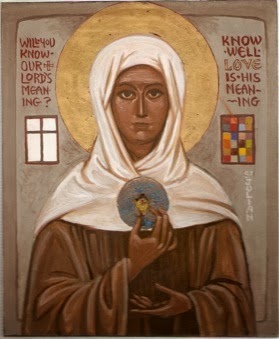
Prayer, day 1928: On the Feast Day of Dame Julian of Norwich


Holy One, your love makes all things new:
creation lifts its voice in praise,
and we rise to give you thanks: alleluia!
In tenderness and sweetness You have created us, O God:
may we live gladly this day to bring You honor.

O God, let us know well your meaning, your perfect wisdom incarnate,
that Christ is love, and we are in Christ.
May we trust in God forever,
assured that we will never be overcome,
though tempests rage about us and travails ensnare us.
For we begin and end in the love in which You bore us, Lord Christ:
as our Mother you bear us for joy and life unending.

Holy Spirit, confirm us in love and hope
as we pray for mercy and compassion
to guide us this day,
and grant us peace.

Amen.
1564


Monday, January 1, 2018

Each Of Us Has a Name: Sermon for the Feast of the Holy Name

The Holy Name of Jesus, Latin, from Ely Cathedral


Hello, and Happy New Year!

Some of you may not know me. My name is Leslie. That name is from the Scottish, and it means “from the gray fort.”

My birth name is Leslie Barnes. This is the name I still call myself in my head.

My name when I am in trouble with my mother, even now at my age (and hers), is Leslie Irene-Katherine.

When I was born, my mother wanted to name me Irene Katherine. My father wanted to name me Leslie. In an act completely representative of my parents' refusal to ever give an inch in the face of the opposition from the other, they smacked all three of those names on the tiny little baby I was. I was the only kid in school who had three names (including a hyphen between two and three just to make it MORE weird), because after all, this was Oklahoma, not Middle Earth, Hogwarts, a camp song, or the British Royal Family. My few Catholic friends (once again, Oklahoma) always asked if that third name was my confirmation or baptismal name, and it took my transition to the Episcopal church to understand what they meant.

Then, when I looked up the meaning of my names, it got more involved. Leslie means “from the gray fort.” Irene means “peace.” Katherine” means “pure.” Barnes is of English or Irish derivation. The English meaning is someone who worked in a barley house, or a barn.

Once I knew the meaning of our last name, when my mother would criticize me for some uncouth behavior by asking me, “Were you born in a barn?” I would smile sweetly and say, “Yes. Apparently I was.”
Sigh. If I must.

So. Apparently, my full name (including maiden name of Barnes) means "From the Grey Fort Peace Pure Of the Barley House." Therefore, according to my names, I should live peacefully and chastely in a castle. Like Downton Abbey!
Liquid Barley.

And make beer.


This explains why I pored (ha ha!) voraciously over baby naming sites when naming my own children, thinking about meanings, sounds, former students who were trouble-makers, as well as initials and what they spelled.

Obviously, names have meaning. And naming something has power. Alexander the Great named 70 cities after himself during his 15 years of conquest before he died. Putting one’s name on something can also be a sign of ownership. It can also be a sign of neurosis, obviously.


One of the hopes of the process of naming is that the power of the name will rub off on the person being named. Thus, names have hopes and responsibilities often woven into them. The bearer of a family name has a responsibility not to bring that name into dishonor. It used to be that the official naming of a child denoted that child's acceptance by his or her family, and names were chosen for their meaning.

There also were some taboos in naming. In the Ashkenazi Jewish tradition, a child should not be named after a living relative. Japan, Sweden, Germany, New Zealand, and Denmark have some sort of limitation on the given names for babies, with Denmark going so far as having a list of 7000 approved names.

Names, especially in scripture, are serious business. One of the first powers that God gives to Adam in the Garden of Eden was naming the creatures God had made—and Adam got to name his wife, too. Now, that’s power.

The Bible is full of names being ordained for children to intimate what they will do as adults. Names are sometimes changed: Abram becomes Abraham, Sarai becomes Sarah; in the book of Ruth, Naomi, in her anger at the loss of her husband and sons, demands to be called Mara instead; Jacob becomes known as Israel after he wrestles with God; Simon becomes Peter the Rock (and sometimes acts like a blockhead). In many of these scriptures, it is obvious that names contain power, which is why some devout Jews today will not actually write the word "God," but use a nickname for God: “Hashem,” which means, surprise! “The Name.” Yes, names have power. Names can be a shorthand for destiny in scripture, myth, and literature.

Even at the end of life, your name matters. Many people throughout history have believed that as long as your name is remembered, you are never really gone after death, which is why we still build memorials to people who have died tragically. In The Book of Blessings, Jewish Prayers for Daily Life, the Sabbath, and the New Moon Festival, Marcia Falk translated this beautiful prayer by the poet Zelda to be used as a kaddish, a prayer in remembrance of the dead: 


Each of us has name

given by God
and given by our parents


Each of us has a name

given by our stature and our smile
and given by what we wear


Each of us has a name

given by the mountains
and given by our walls


Each of us has a name

given by the stars
and given by our neighbors


Each of us has a name

given by our sins
and given by our longing


Each of us has a name

given by our enemies
and given by our love


Each of us has a name

given by our celebrations
and given by our work


Each of us has a name

given by the seasons
and given by our blindness


Each of us has a name

given by the sea
and given by our death


Our names outlive us, and define us, but also sometimes change us.

Today we remember the naming of the newborn Christ child, and why that name matters. Even before his birth, Jesus was given a name by God through an angel. On the eighth day after his birth, which would be today, January 1, he was taken to the temple for his circumcision and naming.

Jesus is the translation of Y'shua, which means, "Yahweh is Salvation." Of course, Jesus was not the only name that our Savior bore.

When we were kids, my brother had a poster on his wall that had all of the names for Jesus on it. Isaiah 9:6, for instance, states that the child born to us shall be called
Wonderful Counselor,
Mighty God,
Everlasting Father, and
Prince of Peace.

Isaiah 53:3 names Jesus as the Suffering Servant by whose stripes we are healed.

Hebrews 2:10 calls Jesus the Author of Our Salvation. Jesus called himself the Way, the Truth, the Life; the True Vine; the Son of Man; and the Good Shepherd.

Then there is the honorific of Messiah, or Christos, the one predicted for generations to be a light to the Hebrews and the redeemer of mankind.

Each one of these names reflects a special role that Jesus takes on for us. Therefore, each one of these names is a gift to us to try to help us, in our limited comprehension, understand the amazing thing that has been done for us through the incarnation of God, which is why Jesus was also called Immanuel, which means "God is with us."

What does this mean for us?

There is a lovely saying from the Midrash, which is the oral interpretation of the Torah rabbis over the centuries, that sums this up:

“In life, you discover that people are called by three names:


One is the name the person is called
by his father and mother; 
one is the name people call him;
and one is the name he acquires for himself.

The best one is the one he acquires for himself.”

It is because of who Jesus is for us that we call ourselves Christians. But what implication does it have for us to take this name onto ourselves?

Calling oneself a Christian in this day and age is a powerful assertion. Sometimes, it makes people nervous to call themselves Christian—they’re not too sure they can live up to the responsibility of that name. Some people who have called themselves Christians in history have not always behaved very much like Jesus. And that’s a problem for lots of us who seek to live into Jesus’s teachings. We have a lot of muddy waters to clear up in some people’s minds as to what it means to be a Christian.

That’s when we can remember all the beautiful names for Jesus, names that reflect his birth, life, and ministry, as well as in our experiences with Christ today. Thos name can help us remember how we can embody his teachings and his love in the world.

Dietrich Bonhoeffer called Jesus “the Man for Others.” He therefore believed the Church is truly being the Church only when it exists for those outside its walls. It starts by reminding ourselves of the names that Jesus carried.

We can remember that Jesus is our Wonderful Counselor—and we can try to be that for others, too, being present with those we meet and listening to them fully, celebrating who they are and the gift of the time we spend with them.

Jesus is the Prince of Peace—and we can try to embody peace, too, which is especially important in a time when too much of society is uncivil, uncaring, and self-centered regardless of the cost or effects on others.

Jesus is Healer and Reconciler—and we can be that too, if we take seriously the power Jesus’s love can have in our own lives, first of all, and let that love work to gentle us, to center us, and to help us let go of the weight of past hurts and anger. We can then take seriously our ability to effect real change in the world, work to heal the broken places we encounter in creation and in each other.

Jesus is the Light of the World—and with gratitude for his healing love, we can remember that we can be bearers of grace and light ourselves by our deliberate choices to walk in his wisdom, humbly, and with intention.

The name of Jesus is powerful indeed! God is indeed with us. Yahweh certainly does save. Jesus is proclaimed as the Messiah, as the point of contact between human frailty and God's infinite wisdom and love, the greatest gift of this Christmas season.

Alleluia!

Preached at Christ Church Cathedral in St. Louis on the Feast of the Holy Name, January 1, 2018.

Sunday, December 31, 2017

Prayer 1800: First Sunday after Christmas


Eternal God,
You gave us your light to show us the way to You:
may our eyes behold your wonder and love
as we raise our praises and prayers to You.

Give us ears to hear and welcome your Word,
Jesus Christ, your only Son,
and bid him enter into our hearts forever.

Transform our hearts and minds
by your holy wisdom
that there may be justice and peace
throughout all creation, O Holy One.

With newborn faith,
let our joy point to your glory,
that our love will be our testimony to You, Lord Christ.

Spirit of Hope,
bend near to all who call upon You,
and pour out your blessing over all for whom we pray.

Amen.


John 1:1-18

Photo: labyrinth window at Church of the Transfiguration, Lake St. Louis, where I preached and presided this morning.