Showing posts with label healing. Show all posts

Tuesday, January 23, 2024

Prayer 4025: Inspired by John 5:1-18 in the Daily Office


God of Compassion,
we praise you and bless you,
tuning our hearts to sing your praise and presence
in all that we do or say this day.

Lord Christ, you healed whenever there was a need,
seeing the suffering and acting without hesitation:
may we also fill our hearts to overflowing
with the desire to act in the name of love and restoration
giving of ourselves freely for the healing of the world.

Make us steadfast in our commitment to your gospel,
and faithful to your example of compassion and generosity,
inspired by your faith in us to live lives of grace,
walking in paths of mercy and joyful service.

Grant your benediction over all who call out to you,
O Worker of Wonders,
and place the kiss of your blessing
upon those we now name.

Amen.

Saturday, August 20, 2022

The Caryatid Set Free: Sermon for Proper 16C


The first time I eve saw her was in Room 19 of the British Museum, a tentative foot stepping forward. A basket was atop her head, supposedly in imitation of the maidens of Sparta who would dance with baskets on their heads in honor of the goddess “Artemis of the Walnut Tree,” Artemis Karyatis. So these sculptures were called “caryatids.”

Once she and her sisters had stood in formation on the Acropolis. In Greek and Roman architecture these slender maidens were given the job of holding up enormous weights and bearing up under incredible force and pressure as a cross between engineering necessity and artistic detail. Together, they bore the weight of the stone roof of this enormous temple and other huge stone structures. The baskets on their heads served as capitals, and their bodies, draped in graceful tunics called peplos, served as pillars. Six of them stood in formation originally at the Erechtheion.

The idea of depicting young women as bearing this incredibly heavy weight offended me at first sight—it reminded me of the typical instruction to young women in cultures everywhere to “Sit still, shut, up, and look pretty.” From a practical standpoint, it seemed delusional to expect anyone so delicate to bear such weight on top of their heads and slender spines-- especially with such apparent ease, their perfect posture denying the laws of gravity and physics.

More than 2000 years later, the great French sculptor Auguste Rodin created a sculpture protesting the impossibility of the caryatid’s task. His work was entitled Fallen Caryatid Carrying Her Stone. And when you know that he pulled and expanded her figure from a detail in an earlier work of art known as The Gates of Hell, looking upon her becomes even more poignant.

Rodin reveals the pathos and the hidden strength in his sculpture. The maiden has crumpled under the weight she has been expected to carry. She is seated, her head turned to one side resting upon her crossed arms as her left hand still cradles her stone as it rests on the curve of her shoulder and neck. Her feet are both still touching the ground, making it clear that eventually her body was driven straight down by the weight she carried, leaving her to rest upon her hips. Her tunic has fallen off her shoulder and lies pooled upon the one leg bent along the ground.

And her delicate face…. Eyes downcast in exhaustion, sorrow, and heartbreak. She wearily rests against her right wrist crossed over her left bicep. Her shape has been remade from a stately column to a crumpled, box-like frame. Yet she steadfastly, diligently refuses to put down her stone. Perhaps out of shame. Perhaps out of determination that she will soon gather the strength to rise again and resume her lonely duty.

Her unlined, youthful face suggests this is the first time she has fallen—and that she may have fallen, but she has not been crushed. She is bent by the load she has been expected to bear, and yet she is never broken. The Fallen Caryatid is a therefore nonetheless a depiction of the darkness before the dawn, of the reserves that lie beneath the surface of one who once danced as lightly as a shadow when asked only to bear a basket, but who is determined to never surrender when asked to do the impossible.


In my mind, I guess I always associated that fallen caryatid of Rodin’s with that lonely caryatid in the British Museum, missing her five sisters. Caryatids are not meant to be alone. There is absolutely no way they can bear their terrible loads, unless the force, the pressure, the weight is shared. I think of that fallen caryatid, and I think there is another point in Rodin’s: with enough kindred to bear the collective weight, she would never have collapsed. Six caryatids upheld the roof of the Erechtheion. One, alone, cannot.

Most of us have experienced weights too heavy for us to bear alone, burdens that nearly bend us double. And yet, dutifully, we too often refuse to put down our stone, or to seek help to share the load.

In last Sunday’s gospel from Luke 13:10-17, Jesus spots a woman bent double by an unknown weight or source of suffering she has been carrying for 18 years. The fact that the people know how long she has been unable to stand up shows that they have observed her suffering for all that time. And yet no help or cure has been found to help this poor woman find relief. Perhaps her pain and suffering have rendered her invisible—or have caused others to look away because they don’t know what to say, or do, or they see in her situation their own worst fears of illness and mortality brought to life. They perhaps have chosen to look away, even though, like the fallen caryatid, her burden is visible and tragic. And so she has persevered simply because she must, for these 18 long years.

She has been carrying on, refusing to be crushed by her burden, just like the fallen caryatid of Rodin’s.

In our gospel, Jesus looks across the synagogue and sees that unfortunate woman bearing her burden with quiet determination. He sees her, sees the real person disguised by the burden she carries. He sees her as a “daughter of Abraham,” worthy of dignity and relief. And he heals her and relieves of her burden.

Jesus sees us, too, and is our companion and comfort in times of suffering and stress. Some of the burdens that try to bend us double—loneliness, a feeling of disconnection, anxiety, hopelessness—can be alleviated by Christ, especially in the Body of Christ in the world, in his disciples joining together and themselves “seeing” and acknowledging the needs of each other, and of the greater world around us, and joyfully responding to our obligation as people of faith to not just see, but respond, as Jesus does. Others of those burdens can be alleviated by the Body of Christ advocating in the world against injustice, poverty, homelessness, war, and racism. That’s where we, as the Body of Christ, join in his healing, transforming mission.

What burdens have you carried that tried to bend you double? Where do you see others suffering?

Let’s look for ways to share the load, for the sake of each other, and in the name of Jesus.


Preached at the 505 on October 20, 2022 at St. Martin's Episcopal Church, Ellisville, MO.

Sunday, April 24, 2022

Wounds, Doubts, and Resurrection: Sermon for Easter 2C


Welcome to our yearly visit with Honest Thomas—the disciple who asks what everyone else is wondering.

You might notice that I do not refer to him as “Doubting Thomas.”

That’s because it is pretty unfair to stick that label on him and not on the other ten remaining apostles. They ALL doubted. And who can blame them? That’s a completely human reaction to have.

Throughout the centuries there has been a hatchet job done on the whole concept of “doubt.” I have heard church people refer to doubt as “the lack of faith.” If you have doubts, they piously intone, you have “lost your faith.”

Not so.

The opposite of faith is not doubt. Doubt demonstrates that you are engaging with the questions before you, seriously. The opposite of faith is disengagement—in not wrestling with the questions, and their impact on our lives, at all. The opposite of faith is not caring, giving up. The life of faith is an active life—it doesn’t take place between your ears, but under your ribs. Faith is not an intellectual proposition to be proved or disproved based on evidence, but a conversion of heart and spirit toward a life seeking after the holy, the good, and the compassionate.

Instead, what I am drawn to thinking about this year as we hear this gospel is the idea of Jesus’s wounds. Not in a creepy way. But as signs of Christ’s solidarity with us.

Too often, wounds and scars are seen as imperfections, something to hide or be ashamed of. They are sometimes used to identify you—and even sometimes make you simply a collection of your wounds and scars, as if that is all there is to any person.

Have you ever noticed that when the authorities are looking for a missing person, they include information about their noticeable scars? Our scars are like our fingerprints—each unique.

Harrison Ford’s got a famous scar on his chin from a car accident, and he gave Sean Bean a scar on his forehead when filming Patriot Games. Harry Potter has his famous lightning-bolt shaped scar on his forehead, and Professor Dumbledore claims to have a scar on his knee that is a perfect map of the London Underground. The evil prince who usurps the throne in The Lion King is actually named Scar. Our beautiful Earth even bears wounds and scars, many inflicted by human activity. As we celebrated Earth Day this last week, I hope that many of us thought of those wounds, and what we could do, each of us, to bring them to healing and recovery.

I thought of the painting by Caravaggio of Jesus inviting what the artist called an “incredulous” Thomas to actually touch those wounds (see the cover image above). Heck, Jesus doesn’t just invite—he takes Thomas’s wrist and drawn him toward his side. Jesus shows Thomas his scars to help prove it’s really him when Thomas, like the rest of the apostles, has a hard time believing that Jesus has been resurrected from the dead. Jesus’s wounds tell the story of love triumphing over death and evil and cruelty.

Our wounds and our scars also each tell a story. When I look at the scars on my body, I remember how I got each of them. There’s a long straight scar on my left leg where it meets my foot—I got that when I was 18, sitting cross-legged on the floor trying to open a hard plastic package with a new doorknob in it. I broke every rule about knife safety I had been taught and turned the blade toward me as I tried to cut open the clamshell packaging. I didn’t feel so good about it either—or the fact that my dad actually almost passed out when he saw the minimal amount of blood as I asked him to take me to the ER. That scar also memorializes the day I learned my dad was afraid of the sight of blood—one of his wounds I could not see.

Then there are scars that are invisible—internal, emotional scars. The ones we bear from heartbreak, or trauma, or abuse, or neglect—and the ones we frequently overlook in others in our rush to judge them. Those scars also tell a story of survival and resilience. Many of us have some new ones after the last few years.

And these internal scars, once we seek help and healing for them, once we accept that they are part of what makes us who we are but not the totality of who we are, are also an opportunity for us to develop empathy and choose a different path, so that we do not, in turn, inflict new scars like ours on others. Thanks to the love of Jesus in the tender hearts of others who have loved me and ministered to me, those kind of scars in my life I have eventually learned to treasure as precious reminders that I have choice, and agency, to break the cycles of pain and suffering that caused others to wound me and scar me. They remind me that I have survived, and that I am more than just my wounds and my scars. They remind me that there is always hope for healing.

Some people are ashamed of their wounds and scars. Our society puts too much emphasis on the idea of perfection being related to looking like you’ve never experienced the touch of pain or aging or just plain old living. That’s not healthy. But scars can also be noble. They are markers of endurance. We can also look at scars as signs of our survival and healing. They are signs of resilience.

As I preached last Sunday on Easter Day, we are being called to live a resurrected life. But even in that resurrected life, we too still bear the wounds and scars of our lives. Jesus’s scars are reminders to all of us that in undergoing death of a cross, Jesus takes the human experience of pain, suffering, and death into the very essence of the Triune God. God truly understands our pains and our traumas—including those we have undergone unjustly, just as Jesus did. Jesus’s scars are reminders of his full solidarity with us as human beings. That healing and resurrection are always possible in our lives, and a promise that our scars may mark us, but they don’t have to shape us.

Jesus showed his own scars to his friends after resurrection because our scars are the signs that we all bear of what has shaped us, for good or for ill. We are all known by our scars—and with what we do with them. Do we use them as excuses to hurt others and leave scars of our own as we pass by? Or do we see them as signs that we have persevered and have healed? After Jesus shows his scars as a sign that the cross did not have the last word with him, Jesus commissions his followers—including you and me, even those of us who have to cross our fingers behind our backs at a lot of the claims made in the Creed-- to go out and continue his work. And that includes acknowledging the wounds and scars and suffering around us, and acting in the name of love to ameliorate them.

That’s part of what “salvation” and “redemption” mean—two words that get thrown around in Christian circles without nearly enough examination. Being saved and been redeemed by Jesus is NOT about what happens after death. It is about what happens now: the grace we receive, the healing we receive, and our obligation and joy to participate in giving that to others.

Jesus, whose name means Salvation, is here, right now, showing us his scars rather than chastising any of us for our questions and our doubts. He shows us the power of resurrection is absolutely reconciling and transformational—that’s the whole point. We can’t wipe away our pasts. But we can move beyond our wounds and welcome the healing balm of God’s love to take us from being a wounded victim to a joyful victor. In showing us his wounds, he invites us as his followers to go out and offer healing and reconciliation to those they encounter by proclaiming God’s power in the lives of everyone.

I have often wondered if Jesus didn’t wince a bit when Thomas touched those wounds—another image to which we all can relate. Jesus demonstrates that this—wounds and all—is his body. This is my Body, broken for you….” we intone at the Eucharist, and often without considering the impact of that remembrance, that statement. Jesus opens himself to us, bodily and spiritually around this altar every time we gather here.

We who have known woundedness are called to recognize God’s love in the wounds of Jesus. Top recognize that, and work to heal the wounds we encounter in the world today, since we are commissioned to action as the Body of Christ.

We can still see the wounds of Jesus all around us, as Pope Francis once remarked, on the bodies of those around us.

“How can I find the wounds of Jesus today? I cannot see them as Thomas saw them. I find them in doing works of mercy, in giving to the body — to the body and to the soul, but I stress the body — of your injured brethren, for they are hungry, thirsty, naked, humiliated, slaves, in prison, in hospital. These are the wounds of Jesus in our day.

"We must touch the wounds of Jesus, caress them. We must heal the wounds of Jesus with tenderness. We must literally kiss the wounds of Jesus…What Jesus asks us to do with our works of mercy is what Thomas asked: to enter his wounds.”


What does all of this mean for us, and our own struggles with faith, and our doubts? Thomas was simply trying to understand the meaning of those events of the last three days—remember that this story takes place on the evening of Easter Day and then seven days later. It’s all still fresh.

I wonder if that was indeed why Thomas needed to see those wounds—wounds that shocked and appalled Thomas even as they confirmed it was indeed his beloved teacher and not a ghost standing before him.

Just like Thomas, 2000 years later we wonder: What did it all mean? How could Jesus die on a cross, and why? What did that death mean—and certainly what did resurrection mean for Jesus’s closest friends and followers? Jesus is reappearing before his friends to remind them that they now carry on his healing, reconciling mission.

We are just like Thomas. But if we ask to see those wounds in the world, we, as the Body of Christ, also commit ourselves to working to bring healing, restoration, and justice to the places where those wounds exist—even if they are hard to see.

Jesus’s wounds are the signs of the power of God, not God’s weakness. They are the signs that Jesus has broken open the ways of death and destruction that governed the world. Jesus’s wounds remind us that our own wounds testify to the possibility and power of resurrection in our own lives through God’s steadfast lovingkindness, mercy, and grace. Jesus received those wounds for refusing to fight evil with evil, as he has been tempted to do from the time of his temptation in the wilderness by Satan at the beginning of his ministry, and as his followers had been tempted to do as the arresting authorities arrived to take Jesus into custody. Violence cannot overcome violence. Only love can. And love in action is the power of God in action-- and our own embodiment of Jesus as his Body, wounded and beautiful all at once.

Jesus invites us to bring our wounds and our doubts to him: they are honest signs of our paths to God, no matter how twisty or difficult. Jesus is our living breathing, wounded Savior who has overcome the worst humans and empires. Jesus invites us into living God’s dream for us and for all creation: a restored life, a resurrected life. Alleluia!


Preached at the 505 on April 23, and at the 8:00 and 10:30 am Eucharists at St. Martin's Episcopal Church, Ellisville, MO.


Readings:


Citations:
Pope Francis, “Touching the Wounds of Jesus,” Morning Meditation in the Chapel of the Dominus Sanctae Marthae,  July 3, 2013. 

Sunday, October 24, 2021

The Gift is the Call: Sermon for the 22nd Sunday after Pentecost, Proper 25 B


One year in the 90s,  when I taught middle school, the choir teacher decided to take her students on a singing tour of nearby nursing homes. She had enlisted me to be a special accompanist that season because they were singing a song that had classical guitar accompaniment, and so even though I am not a classical guitarist, I agreed to give it a go and learned the music. It was a beautiful piece. The bad part was, there was another piece of music they performed which absolutely drove me nuts. It was the theme to that movie, Titanic

And because we were short of sopranos that day, and I was more fully soprano-y back then, so I was asked to stand behind the kids and belt out the melody line in support. Yuck. Couldn’t stand the song, couldn’t stand the movie. I mean, really—plot holes you could have driven an ocean liner through and why didn’t Rose scoot over on that door if she loved Jack so much but she managed to hold on to that necklace? But when we went on our tour, the older folks just ate it up. Which just goes to show you. Sometimes we put our own issues aside and go for it.
We went to three different nursing homes, right around Christmas, and so we also sang some seasonal tunes and a couple of classics from the 1940s as well as those two pieces.

Afterward, the kids would visit with people who were sitting out in the common area and share some treats. We talked to the kids beforehand to prepare them, and some kids were worried, because they didn’t know if they would have anything in common to talk about with people half a century older than they were who were strangers. So we suggested they start out with introducing themselves, and talked to them about shaking hands (not too firm a grip, not too soft). We suggested they could ask residents about what their favorite songs were when they were kids, or pets, or maybe Cardinals baseball or Blues hockey, or their favorite movie stars or movies.

There were lots of people who came out, with varying levels of need. But at the first place we visited, one man didn’t wait. He reached out and grabbed the hand of one of our boys and asked him to sit down and talk with him. He confessed that he had no family nearby and few visitors. He saw his opportunity for a visit, and he grabbed it, literally, with both hands. Soon he was regaling our student with his life as a minor-league baseball player, and giving the kid batting advice. The thirty minute visiting period flew by, and at the end, both the boy and the gentleman had had a great time.

In our gospel today there were lots of people who sat by the gates of towns, and they had various needs. Some came to conduct business, or seek advice, or make a contract with another person, or to ask for alms, like Bartimaeus. Jericho was no different. And Jesus very easily could have passed Bartimaeus by. But Bartimaeus called out and would not be shushed. Just like our friend in that nursing home, he didn’t wait—he asked outright. He perceived an opportunity for help, and he grabbed it and would not be denied. When Jesus hears Bartimaeus’s cry for mercy, he calls him forward. That word call is important—it’s used three times in that single verse alone.

And Bartimaeus responds to that call from Jesus instantly. Even though blind, he “springs up,” throwing off his cloak, and moves confidently, answering Jesus’s question with a bold declaration of Jesus as “My teacher….” The casting off of his cloak, the garment which a beggar used to collect and carry his alms, signifies the throwing off of his old life, the giving up of the possessions urged upon the rich young man we heard about two weeks ago. Bartimaeus is eager to leave his old life behind.

And even though Jesus can probably tell what the man needs, he asks him. For the second time in two weeks, Jesus asks someone what they want from him. Last week we had James and John asking for preferential treatment and honor; this week we see a humble beggar, who sees with his heart and soul what the disciples cannot see despite long experience, asks for his vision to be healed. Jesus doesn’t just assume what Bartimaeus needs—he gives him the dignity of asking for himself.

Jesus heals Bartimaeus’s sight, asking nothing in return, telling the healed man he can go. Unlike almost everything else in our own society, this interaction is NOT transactional. Jesus doesn’t give in order to get something in return. Yet Bartimaeus does NOT go. He stays. He stays and becomes a disciple, rejoicing, not taking the gift he has received for granted.

The blind man sees clearly who Jesus is and what Jesus’s ministry means, even though he is a stranger, not a disciple, and is physically blind. Meanwhile, the disciples with been alongside Jesus for these last 10 chapters have repeatedly shown themselves incapable of seeing and recognizing Jesus for who he is, much less accepting his predictions about his ultimate fate. Here’s what a true disciple like Bartimaeus sees with the eyes of the heart and soul: Jesus came to earth for a little while, filled with the power of God through the Holy Spirit that descended upon him at baptism. In his temptations, he was tempted to use the gift and powers he had received for himself. But instead, Jesus steadfastly insisted on being a conduit of God’s power of love and redemption, to spread wisdom and healing and hope to those he encountered.

Bartimaeus KNOWS what Jesus has done for him, what a gift he has received, and in gratitude he responds by dedicating his life to supporting Jesus and his ministry. This is a story about gratitude—and about giving, perhaps even more than it is a story about healing. It’s a story about how we can live into the ways Jesus calls to us as disciples.

And there’s a lot for us to hear in this story as we begin our annual giving campaign today. We often hear about the three “Ts”—time, talent, and treasure. In the area of sharing our time and talents, there’s all kinds of activities we can engage in, both here at church and in our daily lives. Being a good steward always means being like Jesus, really—and in this particular story, that means being willing to respond to those who are sidelined or silenced by the community. 

Sometimes that response may involve financial resources. 

Those funds are given to literally “treasure” the PEOPLE we meet here even more than the buildings and programs. Empowering St. Martin’s not just for the opportunities for fellowship it provides us but being empowered by that fellowship to hear the call of the world for healing and hope, and be thrilled for the opportunity to give back just a part of the manifold blessings we ourselves have received.

Here’s the practical truth. Each year we ask you for an estimate of your giving for the coming year. We then build a budget off of those collective estimates. And we need to look at what that budget says about our mission and our priorities. What we spend money on in our lives is what we most value. It’s that simple, and that stark. Our giving—yours and mine—is a statement of the depth of our faith and our acknowledgement of our gratitude and our love. Our giving is NOT about using money as a way to settle grievances, or expressing our displeasure or pleasure, a kind of carrot and stick contraption to get our own way. It’s not based on a profit-and loss calculation, on a measurement of how much we first get. No, it’s a way to rejoice for God’s love and presence in your life. It’s a way to live without fear or limitation. It’s a way to be a part of God’s healing work in the world, and to make a real difference.

Sure, some of the money given to St. Martin’s will go to pedestrian things like maintain the building and grounds, paying the light and the heating and cooling bills, finding and fixing leaky pipes. But if that’s all we take care of in the budget, we have failed as a congregation. Even more important, the money we raise each year is a spiritual statement from each of us individually as well as collectively. That statement either empowers us or hinders us as a congregation in our ability to reach out, listen to, and be with folks like Bartimaeus, because we recognize that we have all BEEN Bartimaeus at one time or another.

Whether we engage with someone whose society deems is to be marginalized, or whether we merely keep the lights on for our own sake, our annual budget becomes a spiritual document. It declares to ourselves and to the public our priorities in our efforts to be good stewards and disciples. To follow Jesus on the way. And following Jesus starts, like with Bartimaeus, with gratitude—with recognition for the very real ways Jesus has touched our lives and healed us of our fears, our own willful blindnesses, our tendency to turn inward upon ourselves.

We live in a cynical time. It has become a national sport in some quarters to blame those in need for their situations. We even see so-called Christians engaging in this attitude, even though time and again Jesus models the opposite path: giving because he can. Denying that idea that God punishes people with illness or suffering as we have heard play out in the story about Job in our first reading for the last several weeks—an idea that many people in Jesus’s time held about people like Bartimaeus. That’s why they shushed him at first. Asking for healing was viewed as asking to avoid God’s justice. Again and again, Jesus rejects notions of justice based on the suffering of the most vulnerable. And this story gives us the gift of reminding that above all things we are called to be like Jesus.

We can often close our eyes to the suffering of the world, and refuse to acknowledge the needs of others. We try to avoid placing ourselves in situations where a voice crying out for help can interrupt the rhythm of our lives. That hesitancy can become a weight, like a heavy garment holding us in place, preventing us from following Jesus with our whole hearts, like the weight of that garment Bartimaeus threw aside as he boldly stepped toward the call of his Savior and Redeemer.


Jesus is calling to us, calling to each of us because he loves us and desires to be our companion along the way of this life we are given as an opportunity for connection. This is a moment, right now, when Jesus is specifically calling each of us into the special gift of taking what we individually have, and joyfully, hopefully, faithfully joining together to engage in mutual ministry here in this place. So that we may have life more abundantly. Living joyfully, generously, and open-heartedly. Without the constant anxiety of whether there will be “enough.”

“Throw aside your cloaks, the weights of fear and anxiety that holds you back!” Jesus calls. Throw them aside, and embrace the freedom and the joy of following Jesus.

Amen.

Preached at the 10:30 Eucharist, both online and in person, at St. Martin's Episcopal Church, Ellisville, MO.

Readings:

Notes/ Attributions:
I am indebted to a meditation by the Rev. Todd B. Freeman, pastor of College Hill Presbyterian Church across the street from the University of Tulsa campus, for insight about the gospel reading. And I hope you all in the congregation have forgiven my friends and me from what was then called Canterbury House for all the times we climbed up your fire escape onto the roof to enjoy the night view when we were in college.

Tuesday, May 18, 2021

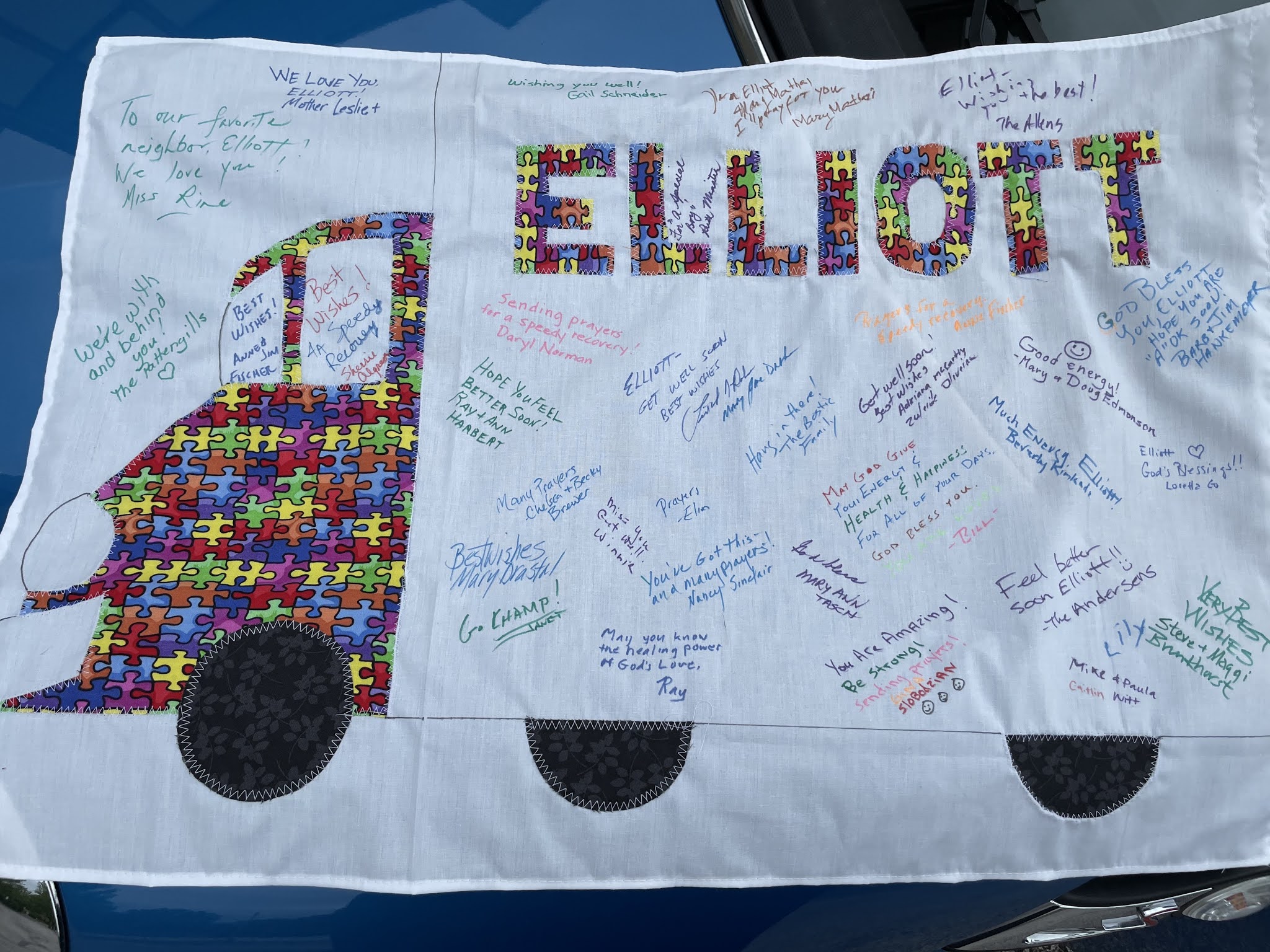
Prayer 3031: For Elliott


Most Blessed Savior,
we worship You and give you praise,
as we turn to you again to rest in your truth,
our model, our brother, our teacher, our guide.

You call us to you in generous welcome, O Christ,
offering the sweets of your wisdom
to all who seek truth, justice, and healing.
We ask for your healing hands to rest upon us today,
curing us of all malice, fear, and faithlessness,
implanting within us the seeds of justice, hope, and unity
that we may flourish and witness joyfully
to the powerful love of God in the world.
Good Teacher, may we be receptive disciples
and walk in your paths of compassion.

Spirit of Wisdom,
guide the hands and the minds of all healers today:
bless doctors, surgeons, and nurses
as they care for the vulnerable
and promote the healing and welfare
of even the littlest ones.
Strengthen those who watch and wait,
and grant your angels charge
over all who seek your respite and comfort
that they may know your abiding presence and protection.
We especially pray for these
who seek your help and your comfort, O God of Hope.

Amen.

Thursday, April 8, 2021

Holy Mackerel: Speaking to the Soul, April 8, 2021


Luke 24:36b-48

I’m away on a retreat to recharge after the busy-ness of the last month. There was a lot of stress involved in trying to manage in person and simultaneously broadcast worship for the first time in a year. That’s why I have some sympathy for the disciples and their jumpiness when I read today’s gospel reading for Easter Thursday from Luke 24. It depicts Jesus suddenly popping up among the disciples like a jack-in-the-box in one of his post-resurrection appearances. And of course, they react with fear and trembling. They think they are seeing a ghost.

Let’s face it: “ghost” or “hallucination” or maybe “dream”—those would probably be the go-tos for most of us if we suddenly saw someone beloved to us appear after we were certain had died, depending upon how skeptical one is. Jesus speaks to them in that beloved, remembered voice. He offers his hands and feet for seeing and touching.

To prove he is a real person, he asks them for something to eat, and they offer him a piece of fish, which he then consumes in their presence, probably while they are still standing with the jaws dropped. But his eating in front of them proves he is actually alive in this body, not wearing it like a costume draped over his spiritual being. And the disciples need that—but even more, they need the grace and forgiveness that is made present by Jesus sharing a table with them again—the place where so much of his gospel of radical forgiveness and inclusion was enacted.

This story comes immediately on the heels of the Emmaus story, where once again Jesus joining his beloveds for a meal is where they come to really recognize him as their beloved Teacher and Savior. It is good for us to remember that the Last Supper wasn’t really the last time Jesus would sit at table with his beloveds. Yet, just like us, the disciples have a lot easier time accepting the crucified body of their savior than the resurrected one. Yet it is vitally important that we see that those-post-resurrection meals serve the purpose of reminding their participants and ourselves as observers of Jesus’s absolute solidarity with us as the Incarnated One who is also the Resurrected One. And by sitting down in fellowship with his disciples and eating with them, Jesus is demonstrating true grace, as he speaks to them lovingly while many of them probably are still carrying the shame of their desertion on Good Friday.

Believe it or not, there is a huge body of speculation over the last two millennia focusing on why Jesus would eat. There are debates about why he ate fish in this incident, and how the fish was digested (yep) if Jesus had no need to eat any more. There’s sympathy for the poor fish who has been caught, killed, and eaten even as Jesus is a symbol of death being defeated.

Holy mackerel. Talk about wading out into deep waters.

Jesus eats with his disciples after the Resurrection to reassure them and to once again declare his steadfast fellowship with them, regardless of their doubts, their despair, and their previous weaknesses. There is nothing fishy about this, either. Jesus continues to be Jesus even after his Passion, death, and resurrection—for the disciples, and for us. That humble piece of fish becomes part of Jesus’s body as a testimony to the power of God to vanquish even the power of death.

These post-Resurrection meals are especially about healing, reminding us all that every time we gather together in the Eucharist, we are joining together in the declaration of community despite physical distance or difference. We are also sharing the table with Jesus, who is both host and guest, just as the Emmaus story reminds us. We proclaim that Jesus is not just Risen, but Alive. Right now. He is not merely the historical figure depicted in the Bible, but living and breathing and bringing the experience of humanity into the Holy Trinity, into the very heart of God.

Jesus once again comes to the disciples where they are, loves them and seeks to bring them peace. As he attempts to set their hearts at rest, he also turns their minds from the past to the future, commissioning them—and us-- to be witnesses to the power of the healing, radically inclusive gospel of Christ. All with asking us for something simple—like a piece of fish—to remind us that he with us—always.


This was first published at Episcopal Cafe's Speaking to the Soul on Easter Thursday, April 8, 2021.

Sunday, February 7, 2021

Each Day a Miracle: Sermon for the Fifth Sunday after Epiphany


In 1967, what was then the greatest rock group in the world, The Beatles, released their album, Sgt. Pepper’s Lonely Hearts Club Band. Part of the album was the story of a fantastic carnival. As the crowd noise and applause fades, the album segues into an altogether different scene, depicted in the song, “A Day in the Life.” The events recounted in the song reveal the highs and lows of one day in the British news. It moves from someone being killed in a car crash, to a story of potholes so numerous they could fill the Albert Hall. And in the center of the song is a recitation of the way that a British everyman begins his day as recounted by Paul McCartney:

Woke up, fell out of bed
Dragged a comb across my head
Found my way downstairs and drank a cup
And looking up, I noticed I was late
Found my coat and grabbed my hat
Made the bus in seconds flat
Found my way upstairs and had a smoke
And somebody spoke and I went into a dream....(1)


Up until last year, perhaps, many of us could have recognized ourselves in that hurried depiction of our days: rushing around in the morning, caffeinating ourselves to make up for lack of sleep, arriving at every place seemingly just on the verge of not making it in time, and then settling into a routine of the workaday world that passes like a dream.

It’s often the way that we treat our days with a casual disregard. Yet, as the writer Annie Dillard notes, “How we spend our days is, of course, how we spend our lives. What we do with this hour, and that one, is what we are doing.”(2)

I don’t know about you, but when you put it that way, I am brought up short. When you apply the microscope to the ways in which I use my precious time in each and every day, it appears I am not doing too well with what Mary Oliver challenges us when she asks: Tell me, what is it you plan to do with your one wild and precious life?(3)  Because my answer is, too often, thinking less about the present than I should, looking too much at the future that the day I am in flows past me unaware.

But what we have seen in the last two weeks in our gospels has been Jesus’s rootedness in the present. We see here in our gospel today and last week a depiction of how Jesus spends one of his days, and not just any day, but a sabbath day, a day that should indicate a particular holiness and dedication to God’s values and God’s sovereignty. He starts it in study and teaching in the synagogue. Jesus teaches with an authority that is previously only granted to the elite scribes who were part of the dominant class in the religious life of that time. Jesus heals, but with an eye to restoring people from being outcast to being welcomed back into being productive members of the communities in which they lived.

Today, in case you did not notice, we see the very first woman mentioned in Mark’s gospel. Now, Mark doesn’t give her a name—nope, she gets defined by what her relationship is with a male relative. She is Peter’s mother-in-law. But then again, at least she gets a mention—Peter’s wife is completely off stage.

Thus the healing of Peter’s mother-in-law is significant in many ways. Jesus moves from the synagogue—a world in which only men spoke and dominated, a less-public space accessible only to insiders who belonged to that synagogue, to a house. This is a public space, as this reading makes clear, where the entire town can approach Jesus. The synagogue was the domain of men. Yet immediately afterward, Jesus now enters a private home, which, although it may belong to Peter, is where women are primarily the actors.

Peter invites Jesus into his home, apparently knowing that his mother-in-law is ill with a fever. Peter has just seen that Jesus is the only one who can heal her, as he's coming off the heels of casting out a demon. Notice that this unnamed woman is defined only in terms of her relationship to a man, and since we get no mention of a husband, we can assume that she is widowed and has been taken into Peter's household to be cared for. Yet in taking in his mother-in-law, the structures of the time would also demand that she is a woman of some in authority in the household, exercising some authority over her daughter by virtue of her status as mother. Therefore for her to be unable to take care of guests entering her home would be a matter of some shame. Hospitality was not a matter of servitude, but honor in this context.

Jesus hears of the woman's fever, goes to her, takes her by the hand, and “raises her up.” The verb used here is the same one used for resurrection. The story then goes on to say that immediately upon her healing, the mother in law gets up and begins to “serve” them, using a verb also used to describe discipleship.


So then the question arises: Was she healed so that she could put together a meal and do the “wimmin’s work” for Jesus and his hungry followers, or was she healed so that she could too, could become a disciple? Perhaps the answer is “Both.” What is clear from this story is that once, she is healed and she has begun serving Jesus and his disciples, she emerges as a disciple herself, and her house gains further honor as the location of Jesus’s healing much of those in the town suffering from any condition that further placed them in a precarious situation of isolation due to their various maladies.

No doubt, after Jesus leaves, the woman who is Peter’s mother-in- experiences a life that is both never the same and yet still places her in a position of servitude that all women in that culture experienced, from rich to poor. But in getting up from her bed, she also becomes, even if it's without the actual recognition by mark, the first Deacon mentioned in scripture. as such she labors alongside Jesus to make Jesus's ministry possible and to enable it -- to empower it. And that is truly honorable indeed. In healing this woman, Jesus also blesses her work and commissions it as being a vital part of bringing about the kingdom. Her service to Jesus enables the rest of his healing mission that day, after all.

What is interesting is that this is also the first time that it is stated that Jesus touches someone, and in this case, the touching happens as a prelude to the healing. He takes her hand and lifts her up. Unlike the healing of the demoniac in last week’s gospel, we do not have any recorded commands of Jesus to the fever—perhaps because it is just a fever. But this is still a miracle, nonetheless. And her service afterward enables more miracles.

There is an everyday miracle embedded in this story that speaks directly to our time in this pandemic in 2021. By entering into Peter's home, Jesus consecrates and hallows the home as a space where Jesus does his kingdom-building work.

Stop and think about that for a minute, and what it reminds us about right now. As we have spent nearly a year being very much confined to our homes more than possibly ever in our adult lifetimes, home has grown ever more important as the place where many of us spend most of our time. Especially for us as a community of faith, as a parish, we have missed being able to be in our sacred spaces. Yet by having Jesus spend much of this day in a home in today’s gospel reading, we were reminded of how sacred a space home can be.

Just like Peter's mother-in-law, we have been confined to our homes because of an illness --or at least because of the fear of an illness. Many of us have rightfully and logically chafed at this enforced domesticity. And yet the story of the healing of Peter’s mother-in-law reminds us but the home can be just as sacred space and as much a source of healing and discipleship as the most beautiful cathedral on earth. Jesus takes an ordinary place and turns it into an extraordinary locus of healing and renewed hope.(4) 

Even by the middle of that one day, Jesus’s fame as a healer has gotten spread about, and people are brought to him to be healed of either physical or psychological/spiritual maladies. Jesus willingly heals those who come to him. Since illnesses made it impossible for most of these desperately poor people to work, Jesus spends a large part of this long day restoring people to independence and hope.

Before the next day begins, Jesus sneaks out before dawn and goes to “a deserted place” or “wilderness place” to pray by himself. Unlike in Luke, Jesus as a person who prays is an incidental in Mark’s gospel. And he only gets a few moments to himself, for, as our text states, the disciples “hunt” for him.

We get a lot of details about what people want from Jesus in these first few verses of Mark, but not much about what Jesus wants from his companions. Number one might be time to pray in peace. Anyone who has been a parent may be able to relate to this. And the disciples are still greatly dependent upon him—they may have followed Jesus, but they certainly don’t yet understand him. Only the evil spirits have that gift. What irony. And, not wanting to be clingy, they cloak their “hunting” and bursting in upon Jesus with the excuse that “everyone” is looking for him.


So Jesus puts aside his prayers for now, and continues upon his mission, stating that they should be moving on into neighboring towns so that he can continue to spread the gospel. Jesus never rests. This remains true today. But he also honors time spent in solitude with God, listening as much as talking-- an important part of prayer that we often forget in our hurried, transactional world. Jesus also never stops praying, teaching, or healing. And neither should we.

This past year has forced some of us into solitude, or at least caused us to drastically contract the places to which we feel comfortable traveling. But what if perhaps we could try to find in our enforced stillness an opportunity for spiritual growth?

As disciples, our jobs are to try to imitate our teacher as much as possible. Jesus is our teacher, and our healer, who calls us to repentance and reclamation of our one wild and precious life. What can we learn from this “typical day” of Jesus’s?

Perhaps this: How can we place ourselves more in the present like Jesus did in this one ordinary, extraordinary day—to see the people right in front of us, in all their need, and rather than flick our eyes on to the next thing, instead reach out to them and lift them up? Can we dedicate ourselves to the same deeply rooted spiritual life that Jesus clings to as he repeatedly is found in prayer, and imitate that, if only to see what effect it might have in our lives?

Can we see even the nameless people around us, like Jesus sees Peter’s mother-in-law, and honor the common life we have together thanks to their labor, and honor them for it, rather than take them for granted, or worse, take pride in our exploitation of their labor at the cheapest rates we can negotiate?

May we never forget that the most visible testimony anyone who claims the name of Christian gives to the watching world is the way that we spend each day. What are we testifying to each day? How can we make each day a miracle for those who would otherwise be overlooked? This is the heart of the life lived by Jesus’s disciples-- which is to say, by you and me.


Amen.

Preached at the 10:30 am online worship service at St. Martin's Episcopal Church, Ellisville.

Readings:


Citations:
1) John Lennon and Paul McCartney, "A Day in the Life," from Sgt. Pepper's Lonely Hearts Club Band, 1967.
2) Annie Dillard, The Writing Life, 1989, p. 31.
3) Mary Oliver, "The Summer Day."
4)Debie Thomas, "A Day in the Life," Jan 31, 2021, at Journey with Jesus.


Friday, January 29, 2021

Prayer, day 2927


Creator God,
come shine your light through us,
that we may be enlightened
and strengthened in our path through this day. 
Drive far from us all hardness of heart,
and guide us to seek reconciliation and amity. 

Come, Lord,
place your hand of peace
upon those who are in strained relationships,
or are alienated from those who love them.

Come, Jesus,
place your hand of power among us,
that we may work in fellowship with the oppressed. 

Come, Holy Spirit,
and place your hand of healing
upon all who are needful, in mind, body, or spirit
as we pray.


Amen.

Tuesday, May 5, 2020

Prayer 2655


Almighty, Eternal One,
we lift our hearts to you in hope:
fill us with your grace and lovingkindness,
that we may be witnesses to the world and beacons to your truth.

Your generous hand upholds us all,
O Great and Beautiful Mystery:
Your steadfast love is the foundation of all that is,
and we praise You and bless you with grateful voices.

The marvels of your creation dazzle our eyes,
and everywhere we look
we see the intricate work of your fingers,
O Foundation Wisdom and Truth.

May we stand in wonder in the paths of your compassion,
and humbly seek to embody your love, Lord Christ,
walking reverently upon the earth,
as companions in love and faithfulness.

Merciful One,
strengthen the hand and hearts of the healers.
Grant your protection
to all who place themselves in harm's way
for the sake of others,
and all whose needs we lift before You as we pray.

Amen.

Tuesday, March 31, 2020

Prayer 2619: Nurtured by God


O Nurturing One,
You are our Light and our Dwelling:
accept our praise and our homage this day.

May we be kind and virtuous in our path today,
that we may be vessels of your truth, O God.
May we pattern our steps
to reveal your generous grace, Lord Christ,
to allow it to work within our souls
and lead us to compassion and integrity.
May we walk mindfully and gently
upon this greening earth,
and in grateful companionship with each other.

God of Mercy,
bless the hands that heal,
and strengthen the hearts that soothe
all those who are in pain, illness, or anxiety.

O Ground of Our Being,
root us in your love and strengthen us in hope,
that we may serve you with devotion and gratitude.
Pour out your blessing over all who seek You,
and give light to the hearts of those for whom we pray.

Amen.

Saturday, March 14, 2020

Prayer 2602: In Time of Fear and Pandemic


God of All Mercy,
we praise You and bless You,
and put our trust in You,
for You are ever-faithful,
and your tender gaze is ever upon us in love.

Let us take your hand today,
O Shepherd of Our Souls,
and be strengthened within your embrace,
that we may care for each other steadfastly.

Spirit of Wisdom,
bless the healers and caregivers,
the scientists, doctors, nurses,
whose gifts are especially in need at this time,
and give us the will to support them and each other
in this time of crisis.

Blessed Savior,
help us to be your hands
to soothe the anxious,
to protect the vulnerable,
to seek out the isolated,
to give selflessly from our abundance
for the support of all,
so that all may be safe and secure.

Knit us together as one body,
Almighty One,
that we always hold fast to our unity as your children.
Bless us as we seek to embody your love,
and spread the awning of your mercy
over all for whom we pray.

Amen.

Tuesday, February 25, 2020

Look!


As we learned how to read, were we 
beginning to forget to look, 
our young eyes caught in tangles of print 
so that imagination was choked? Were we 
trapped at that remove from ourselves? 

Or did we begin to see a new way, with eyes 
that widened in the amazement of reverie, 
memory, invention? As we peered 
between the words, could we make out 
shapes and colors beyond them?

What did our inside eyes make of 
the black marks on creamy paper, on onionskin? 
A dream of angels turned real, perhaps. 
A wooden boat on a lake. Three small loaves 
fragmented to fill all those empty mouths 

and baskets. Or this: a blind man 
opening his eyes so that the first face he sees -
a vision, surely - is Christ's, spittle 
still shining on the quick fingers, 
his mouth saying urgently, Look

—Luci Shaw (1928- ) from Accompanied by Angels: Poems of the Incarnation

Friday, January 31, 2020

Prayer 2559: A Prayer for Those Who Work for Good


Most Merciful God,
thank You for your sheltering presence over us
as we walk the path of discipleship this day. 

Bless the hands of the healers--
doctors, nurses, caregivers,
parents, children, spouses,
partners, friends--
who work with quiet determination 
for the relief of pain, disease, and suffering, 
who watch over and wait upon those who are ill.

Bless the minds of the dreamers-- 
the scientists, the organizers, the teachers--
who see potential where others see problems,
who see what could be
and are willing to work to make it happen.

Bless the strength of the guardians
who seek to serve and protect all
against those who would harm others
either in defiance of or in the name of the law.

Holy One, envelop with in the cloud of your mercy,
and grant your peace to those for whom we pray.

Amen.

Monday, December 30, 2019

Prayer 2527: For the Helpers


O Great Provider,
Beneficent and Compassionate One,
we lift up our hearts in prayer,
seeking to center ourselves in your mercy,
that we may be a blessing to others this day. 
You are the Ground of Our Being
and Source of Our Hearts:
we give thanks for your blessing and love. 

Merciful God, strengthen the helpers today: 
those who work for healing; 
those who seek to ease suffering and pain; 
those who comfort the lonely 
and stand alongside the abandoned; 
those who work for true peace 
founded on justice and equality; 
those who welcome the stranger and refugee;
those who live out their lives as love in action. 
And then, O Wisdom,
make us helpers, too.
For this is true worship:
to serve You and serve each other.

Each breath we take is a gift from you, 
O Creator and Redeemer. 
As faithful people, 
may we turn our intentions toward compassion. 
May we reflect hope against despair,
light against darkness,
and enlightenment against division and prejudice,
O Light of the World.

Holy One,
we know that you are with us and alongside us
in joy as well as in sorrow or pain:
grant that the blessing of your peace and presence
may be made visible to all,
especially as we lift up these beloveds to You.

Amen.