Showing posts with label cross. Show all posts

Sunday, February 25, 2024

Bearing the Name, Bearing the Cross: Sermon for Lent 2B


What’s in a name?

Shakespeare first famously asked that question in his tragedy of Romeo and Juliet, a tale of two star-crossed lovers whose families were at war with one another in the streets of Verona. The Montagues and the Capulets were openly at each other’s throats—and Juliet Capulet and Romeo Montague fall in love at first sight, despite their families enmity.

In Act II, scene II, the subject of names is the main topic. Juliet sits at her window and muses these famous lines, with Romeo lurking out of sight in the orchard beneath, listening in:

What’s in a name? That which we call a rose
By any other name would smell as sweet;
So Romeo would, were he not Romeo call’d,
Retain that dear perfection which he owes
Without that title. Romeo, doff thy name,
And for that name, which is no part of thee,
Take all myself.

Of course, it is not Romeo’s given name that is the problem. The problem is his family name—and hers, for their families are at war under the banner of those names. Their names, and the communities each represents, threatens to forbid their love.

Names are important banners we wrap around ourselves, but they are NOT individual. They tie us to other people, to nationalities, to ideologies, to kin and kindred spirits scattered far and wide. Most importantly, most names are shared, and thus they establish boundaries and expectations for entire communities.

In our readings today, the idea of names and their symbols lies under all our readings. Abram, although a wealthy and faithful man, risks having his name die out, for he has no legitimate children. Yet even though he is 99 years old—about which St. Paul made an incredibly ageist crack in our epistle—we see a second covenant in two weeks, as God promises Abram descendants so numerous that his name will never die, and he will be the father of many nations. 

To emphasize this, God reveals a new name for everyone involved in this covenant. The name used here for God, meaning “God Almighty” or “God of the Mountain,” is “El Shaddai” in the original text. Abram, meaning “Father is Exalted,” become Abraham, which means “Father of a Multitude.” Sarai, which means “Princess,” becomes Sarah, meaning “Mother of Nations.”

In our section from Romans, Paul is writing to the followers of Jesus in Rome, although he has never met them. They are struggling with the requirements to form a community of Christ- followers, with those of Abrahamic heritage arguing about whether gentile converts should have to follow Jewish law before admittance to the community—including becoming circumcised, which was also mentioned in the verses omitted in our reading from Genesis. Paul makes a case that, as Jesus is the fulfilment of the Law, and underlying this is the idea that Abraham was the father of nations, plural, that anyone who shares the faith Abraham had in God is therefore a child of Abraham’s promise, through faith alone. In other words, one follows God by faith, not by bloodline --or painful surgical procedures on tender bits of one’s anatomy. Ouch.

In our gospel, Jesus is talking about what it means to be a true disciple and follower of Jesus as the son of God. And it is here that we must remember that each gospel was written for a specific community at a particular time and place. The Markan community was undergoing great persecution and suffering—so these verse that we might draw back from were written to comfort the listeners, to remind them that their suffering was in allegiance with someone who died out of love for them and for the entire world on the cross. The cross, which had been a symbol of shame, is now a symbol of the victory and power of love in action—self-giving love, that seeks to draw all creation into community, bound by self-giving love.

And here we are, two thousand years later. The name we choose to bear as followers of Jesus, is “Christians.” And it is a name that lays a lot of obligations on us—the first of which is to be guided by love, always. Love that is willing to seek another’s good even at our own expense, just as Jesus exemplified in every moment of his ministry.

Sure, we live in a time when, in our context, following Jesus generally is not going to expose us to a torturous death—although that IS certainly true in other parts of the world, even today, and we should never, ever minimize or forget that.

But following Jesus—not just using his name to hammer other people, but instead living open-heartedly according to his precious gospel—certainly will set us at odds with the culture in which we live. And the way Jesus’s name is used by too many people today is 100% in opposition to Jesus’s message. 

Tragically, some people use the name of "Christian" as a weapon against others and to make themselves feel superior, members in a rarified club. And they use the name of Jesus as a club against anyone they consider “less-than.” They use the name of Jesus as an excuse to contemptuously deny the humanity of those they believe don’t measure up—the very poor, outcast, and oppressed with whom Jesus spent most of his time standing in solidarity. And so, they risk tarnishing the holy name and true gospel of Jesus in the public sphere. They forget that taking on the name “Christian” is about serving others, especially those the world around us despises-- rather than serving yourself.

The core of discipleship, of bearing the name of Jesus with integrity, is self-giving compassion and generosity, Jesus reminds us continually, especially in this season of Lent. Tragically, that certainly is not something in line with our own culture, where self-indulgence is raised up as a virtue. It is at this point especially that Jesus makes it quite clear that the gospel is certainly counter-cultural throughout the ages. And it is still counter-cultural now, surrounded by the myth of “rugged individualism,” in which any need for someone else is portrayed in the public American ethos as a failure.

But that is exactly the kind of life we are challenged to lose and lay down if we want to bear the name of Jesus faithfully and call ourselves “Christians.”

It is that life of selfishness and disdain for others that Jesus encourages us to lay down and lose. Losing that life is the only way to open yourself to living in harmony with Jesus and following him as God’s beloved children. Peter is rebuked for thinking in a worldly way, wanting a warrior Messiah. But that is NOT God’s way.

So, we too are asked to look at the life the world encourages us to lead critically. We are currently in a crisis of loneliness and isolation that has NOTHING to do with COVID but everything to do with the myth that our families and communities can survive when greed and contempt for others are worshiped are embraced to rule over us as gods. Suicide rates, addiction, and violence plague our every step in every community, regardless of wealth or zip code. Antisocial behaviors have been normalized and even applauded and laughed about. Cruelty is sport.

It is THIS life Jesus urges us to lay down and lose in order to have life in him and bear his name as Christians faithfully. We gain so much more than we lose!


The cross in Jesus’s time was something shameful, yet for us now it is a sign of faith and hope. The cross has been so transformed by the power of the self-giving love it represents that we now wear it around our necks, hand it over or behind our altars, and regularly make the sign of the cross over ourselves as we are blessed or absolved.

When I became an Episcopalian, I embraced the habit of genuflection, because it reminded me every time I did it that Christ has asked us, as Christians, to take up our cross—a cross of love, service to others, and community—and follow him, as our gospel recounts today. It is a reminder to me that the Holy Trinity is ever near. And it is a sign, as much as the name of Christian, that binds us all together in one family, one community, one faith—all centered on self-giving love in action for others. The cross and what it stands for is NEVER to be used to divide us.

During every Eucharistic prayer, as part of our Catholic, meaning universal, identity, we are all encouraged to make the sign of the cross over ourselves as the Holy Spirit is called down to consecrate US as well as the bread and the wine—to remember that the cross is a sign of the victory of love and the generosity of God to us in feeding us around this altar a meal which makes us one body sharing one name and one ministry, one obligation to each other—the name of Jesus, the sweetest name in the world.

So today, I challenge you and myself, to take up your cross of love and bear it with joy, right now. Realize the gift of renouncing the suffering wrought by the world’s values. Lay down that life with joy, and take up the life of love, faith, and hope in the name of God. Let us commit ourselves, starting this Lent, to follow Jesus in truth, bearing his glorious name in word, but more importantly in deed, as we all seek to be a blessing to the world around us.


Preached at the 505 on February 24 and at the 10:30 Eucharist on February 25 at St. Martin's Episcopal Church- Ellisville, MO.

Readings:


Amen.

Wednesday, February 26, 2020

Taking on the Cross: Homily for Ash Wednesday


It is on this day that we prepare to enter the season of Lent, and that we are encouraged to take stock of any sins we have committed, any repentance we need to make. It is also a time when many of us who attempt to observe a holy Lent are often prone to “give something up” for Lent: swearing, or drinking soda pop, or chocolate, or electronics. Some of us fast from all food or simply meat on Ash Wednesday and on Friday. The taking on of such a special discipline is meant to help us focus our priorities during the 40 days of Lent, from being reminded of our mortality on Ash Wednesday through the somberness of Holy Week, to emerge in the glorious resurrection light of Easter. 

But what if we looked at this from another angle? What if we thought of this as a chance for true repentance—a literal turning from away from one thing in hope of something better? Rather than giving up, what if we set an intention for ourselves to give in, with an emphasis on the word “give?” What if we used this Lent as a chance to give in, to look in, to lean in--- to try to surrender fears, attitudes, and failures of heart that separate us from the love of God we are called to embody, to take into our very heart and soul and mind. When we surrender these things, there is then a space hollowed out in our hearts that can be filled with Christ. 

Many people comment on the irony of wearing ashes publicly after we have heard a gospel reading that warns against making a show of religious observance. But Jesus is not talking about the wearing of ashes in our gospel. Perhaps the key lies in the fact that we ourselves get so caught up in the idea of the exercising of public piety, that we often lose sight of how Jesus defines that piety—not as ashes marked on our foreheads, but on the three vehicles he highlights: giving alms, praying, and fasting, which were the three most common outward practices of an observant Jew in those days.

When we give alms, we are called to give to others without rules or expectations or demands.

When we pray, we are called to listen even more than we speak, and to place ourselves somewhere where we can hear the voice of our Beloved Savior speaking to us. 

When we fast, we are called to clear away distractions to focus on what really matters. 

Rather than make a game out of our own will-power, we’re actually called to give ourselves over to the will of God in our lives turned outwardly rather than inwardly. 

The difference lies in intent. Our reading from Joel urges us to strip away all the masks that separate us from focusing on God when it urges us to “rend our hearts, and not our clothing” as a sign of our repentance over where we have fallen short and sinned in the previous year. In other words, Jesus calls us to lay down the illusion that we can hide from God, or ourselves and to take the risk to be open and humble before God—and even, harder, to trust in God’s promises. Jesus calls us to strip away barriers, but also the false fronts we put on as a shallow defense against self- knowledge and change. 

The word translated as “hypocrites” here often in the original Greek had a meaning closer to “play-actors.” In Greek theatre at that time, of course, actors wore exaggerated masks so that even those in the furthest seats could see the expressions. Of course, this meant that the actors’ true selves were hidden from view. On the one hand, then, to act as a play-actor is to make a mockery through exaggeration, to overact or mug before the audience. It is said that an actor lives for the applause. Jesus’s remarks here also lead us to ask ourselves about the motivation behind our actions. Are we doing religious things so that we can be thought of as good, or doing good things for their own sake? 

If we are honest with ourselves, most of us know an awful lot about wearing masks. And the reality about those masks is that they may fool the people around us, but they certainly don’t fool God. God knows exactly who we are: our hurts, our self-delusion, our false pride and secret fears. And yet God loves us anyway. Loves us—and encourages us to drop the masks and allow ourselves to really be seen. To be seen—and freed to do the work of discipleship that grounds us in love of God and love of each other. 

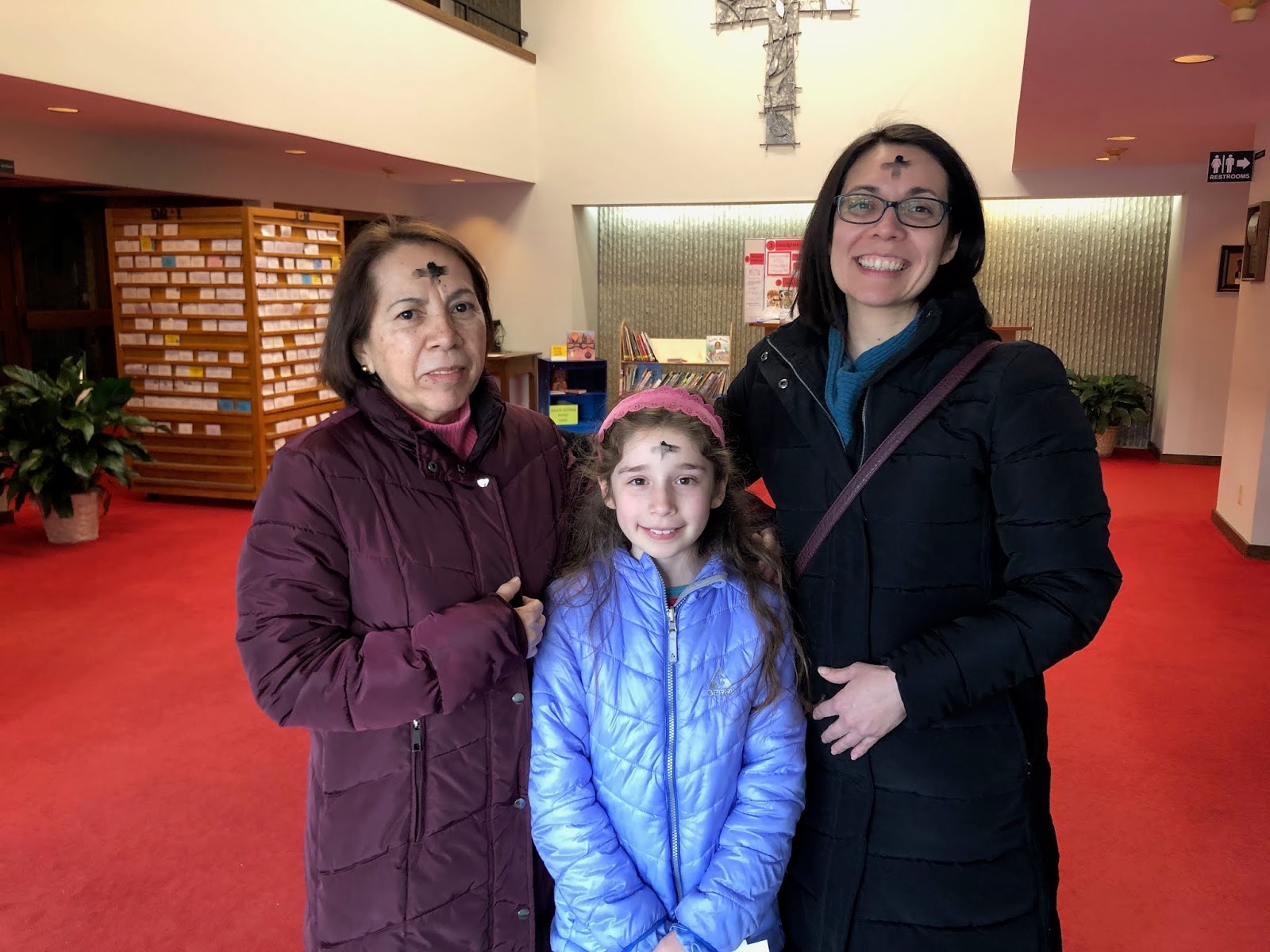
The marking of our foreheads with ashes comes with a reminder that we are made from the dust, and to the dust we shall return. All of us. But the ashes are also mixed with oil, to remind us that we have each been chosen by God as beloved, anointed to spend these 40 days rededicating ourselves to Christ’s service. 

And to these two precious elements, we add a third: the shape of the cross. The two lines that are drawn upon our foreheads with this dust are in the shape of a cross—reminding us of a love that never gives up on us, ever, that calls us to new life even as we remember our bodily mortality. It is on that cross that we are drawn straight into the open embrace of Jesus, with his arms outstretched upon that cross, showing us that Love Always Wins. 

 So, putting our masks aside, let us humbly take on the loving emblem of the cross—and let our hearts be shaped by the Love that calls us to repentance without ever abandoning us. 

Amen.

Preached at the 12:00 Eucharist at the Fountains of West County, and at the 7:00 pm Eucharist at St. Martin's Episcopal Church, Ellisville.

Readings:
Joel 2:1-2,12-17
Psalm 103 or 103:8-14
2 Corinthians 5:20b-6:10
Matthew 6:1-6,16-21


Sunday, February 23, 2020

The Light in the Valley: Sermon for Transfiguration Sunday A


The disciples had spent the previous six days in shock. Peter had just proclaimed Jesus the Messiah—and Jesus had thrown cold water all over that by explaining that he was going to be handed over to those who feared his influence. Turned over for suffering and death.

 Six days… just like Moses was up on the mountain, being given instructions for the tabernacle and the ark that would accompany the people. Six days… like the six days of creation. 

Peter and John and James go with Jesus—and instead of merely joining him in prayer, they receive a vision before them that tears back the veil and offers them a glimpse of the very glory of God. It’s like they are jolted into a new awareness. It’s electrifying. And so Peter, the disciple most like so many of us, babbles the first thing that pops into his head. Who, after all, wouldn’t want to continue to wish to be dazzled, to have proof of God’s glory paraded in front of their watering eyes?

Maybe Peter is thinking that if they build little dwellings for each of the three great prophets revealed in the transfiguration, they can all just stay there forever, in this experience that seems so dazzling it seems outside the strictures of time, itself. Maybe, also, Peter reflects that tendency we all have to try to domesticate God, to place God within defined boundaries. You know that tendency—the one that seeks to control how much we are willing to cede to God, while ultimately trying to retain control of the rest of our lives—like limiting our worship and seeking of God to Sunday, so long as the rest of the week is ours to do what we like.

I don’t think Peter meant it that way—I think he had just experienced something that had reset all his synapses, and maybe he wanted to stay there until he could figure it all out. That’s relatable, too. In the press and crush of daily life, how wonderful to have some time set apart in the presence of glory. I am convinced that most of us crave that mountaintop experience—even as we fear it, and wonder if we wouldn’t lose our minds at actually experiencing a theophany such as this one.


Mountaintops, after all, offer a sprawling vista to view. They give you a sense of perspective. They remind you of how big the world all around you is. They lift you up above the doubts to a plane or altitude of certainty.

Mountaintops can also make you afraid for that very same reason—you can see how big the world all around you is, and move like a chess piece to the next logical thought—how small and insignificant and frightened we are. Maybe that’s also part of why Jesus urges his three apostles to come back down to the reality of the job at hand, down in the valley. And I wonder how long Peter and the others could have managed to stay there, anyway. And so it is in the life of faith—or more realistically, the life spent wrestling with and pursuing faith, and even sometimes fleeing from it. 

What strikes me is the tension between the mountain and the valley in this passage. As we close Black History Month, we remember one person who spoke so movingly and lived so honestly into that tension between the mountain and the valley. 

I am reminded that the Rev. Dr. Martin Luther King Jr., on the night before he was assassinated, spoke of the transitory nature of the mountaintop experience—that it show us what can lie before us, but until we go into the valley below we remain stuck in a way, unable to take possession of the good things God offers to us—even in the midst of struggle and work that is also the life of the disciple. 

Recalling that Moses himself was brought to the mountaintop to look down into the promised land—to see it, but not to enter it—Dr. King reflected on a previous attempt to take his life, and spoke with numerous death threats that had been leveled at him, even here. He knew that his work the next day, trying to help striking sanitation workers in Memphis, would not be met with joy from all quarters, to put it mildly. His mountaintop experience also served to remind him that the real work was down the mountain and into the valley. 

In our own time, people climb mountains for fun, for the challenge of it. They seek the thrill of going where the air is thin and the Earth curves away at your feet on all sides. Yes, we crave that mountaintop experience. Down in our everyday lives sometimes it’s hard to see that perspective of being on top of the world. The life of faith right now, 2000 years after the apostolic era, is often one of straining toward faith against the cynical tide of our time. 

Yet notice that Jesus knows where his work is—it is among the people, the poor, the oppressed, the forgotten, the discounted. Jesus knows that the glory within him has been there all the time. That’s perhaps why he doesn't engage Peter in his idea of building shelters for Elijah, Moses, and the transfigured Jesus. Jesus’s transfiguration is meant not to separate Jesus from us, but calls us to elevate our own understanding of the same glory implanted in each of us, as the poet and priest Malcolm Guite describes in one of his sonnets:

The Love that dances at the heart of things
Shone out upon us from a human face
And to that light the light in us leaped up,
We felt it quicken somewhere deep within,
A sudden blaze of long-extinguished hope
Trembled and tingled through the tender skin.(2)

Peter, James, and John are electrified and terrified by their brush with the Glory of God—and yet also rooted to the spot by it. However, Jesus reminds them that their work, the work of discipleship, of being co-workers in God’s kingdom, is not to be accomplished hiding from the world on some mountain. 

The glory exposed on the mountain is not tied to being on the mountain. To really make the glory visible to all, we have to come down and engage in the work of discipleship. The work is down in the valley, where everyday people are waiting for instruction, hope, and healing. 


This is the turning point in Matthew's gospel, midway between Jesus’s baptism and his death. Now he will turn his face toward the cross-- a parallel scene to this one. On the cross, Jesus will also be between two figures—the two criminals who were crucified with him. On the cross, his claim to be God’s son will be inscribed over him as a form of mockery, for surely the true Son of God would not be hanging on a cross. While he is on the cross, the crowds will wait around to see if Elijah will come to save Jesus. Three of Jesus’s followers will witness his crucifixion, although they will be women (Mary Magdalene, Mary and Salome, in this gospel). And thus we turn to face the cross, and prepare ourselves to enter the season of Lent. 

But first, today, we will celebrate a transformative event, a baptism, in the life of one beloved child of God and her family—and that family includes us. Together with Chelsea, we will recommit ourselves to our own baptismal promises—and they are not promises to take lightly. They are a recommitment to living a Christ-shaped life, one that takes seriously not just the reflected glory on the mountain but the work awaiting us as beloved children and heirs of God, entrusted with the work of discipleship. That work of discipleship is not about creating a cozy club of insiders sneering out those on the outside, as some would have us believe. 


The work of discipleship is exactly the opposite: to draw the circle ever wider, to reflect Christ’s glory in our own daily lives not because we are told to but because we are willing to open ourselves up to being filled to overflowing with the love God has for the world and to channel that love in tangible action for healing, reconciliation, compassion, and renewal down in those valley spaces in society.

May we remember the ways we can bring that glory to shine for all to see—the glory of Christ that resides within each of us, the glory that calls the world to God because we are made for God. It is a reminder of the new creation we all become when we turn our lives over to Christ and take our places alongside him, boldly, bright with hope, coworkers for the kingdom. May we all be brave enough to step down from the mountain alongside Jesus. 

May we all be sustained by hope and purpose in eagerly taking up the work that awaits us in the valley, sustained and uplifted by Jesus’s never-failing presence and reassurance beside us and carry the hope and promise of the transfiguration into the darkened world.

Amen.


Preached at the 505 on February 22 and at 8:00 and 10:30 Eucharists at St. Martin's Episcopal Church, Ellisville.


Readings:


Notes/Links/Attributions:
1) Top image: Armando Alemdar, Transfiguration.
2) Malcolm Guite, Sonnet for feast of the Transfiguration, at 
https://malcolmguite.wordpress.com/2012/08/04/a-sonnet-for-the-feast-of-the-transfiguration/

Friday, April 19, 2019

Prayer, day 2273: For Good Friday


O God,
for You alone my soul in silence waits.
Into your hands, O God, I place my spirit,
for I know indeed that You are my home and my shelter.
We turn to You, O Merciful One,
and remember the love you have embedded
in each breath we take.

Lord Christ, you took on the cross,
the point where darkness and light meet,
and opened your arms to embrace us eternally:
may we kneel at your feet and repent,
crucifying our fears, our divisions,
our callous indifference, 
o live eternally in You.

Blessed Jesus, You are lifted up before us,
offering yourself in freedom to lay down your life
to overthrow the power of death:
may we take up our cross of love, and follow,
embracing the light of God.

Spirit of the Living God,
You sustain us in every moment:
abide within our hearts,
and grant your protection to those for whom we pray.

Amen.

Friday, March 30, 2018

Prayer 1889: Good Friday


O God, 
for You alone my soul in silence waits.
Into your hands, O God, I place my spirit,
for I know indeed that You are my home and my shelter.
We turn to You, O Merciful One,
and remember the love you have embedded
in each breath we take.

Lord Christ, you took on the cross,
the point where darkness and light meet,
and opened your arms to embrace us eternally:
may we kneel at your feet and repent,
crucifying our fears, our divisions,
our callous indifference,
to live eternally in You.
Blessed Jesus, You are lifted up before us,
offering yourself in freedom to lay down your life
to overthrow the power of death:
may we take up our cross of love, and follow,
embracing the light of God.

Spirit of the Living God,
You sustain us in every moment:
abide within our hearts,
and grant your protection to those for whom we pray.

Amen.


Photo: The Crucifixion from the Passion side of La Sagrada Familia in Barcelona.

Sunday, February 25, 2018

One Wild and Precious Life-- Sermon for the Second Sunday in Lent, Year B


Y’all, I have something to share with you.

I hate winter.

I am one of those people who walks around in January and February asking myself why, exactly, I live someplace where the AIR hurts my FACE, and where even the act of walking can become an act of bravery.


What could go wrong? Yeah... no.
And then there’s the Winter Olympics, which combines sport with misery in ways that boggle the mind. I mean, one of the main sports in the Olympics involves couples throwing each other around and twirling each other over their heads while there are knife blades on their feet, and trusting that no one will hurt the other!

And if ever there was a metaphor for marriage or any long term relationship, there you have it.

I watch the Olympics, and I wonder who in the world invented curling-- except as maybe a drunken joke that the Canadians are pulling on the rest of the world. Only Canadians could combine shuffleboard with housework and put it on ice. We’re actually watching people trying to influence the course of a rock with a handle on it slide on an ice rink. Maybe it reminds me too much of watching people drive during the ice storm on my ordination night the December before last, but I don’t get it. 

I’m a summer kind of person. Summer is glorious, but winter. Lasts. Forever. Summer is lush and abundant, while in winter, everything shrinks. And gets chafed and raw.

That’s why I love this poem by Mary Oliver(1), called “The Summer Day:"


Who made the world?
Who made the swan, and the black bear?
Who made the grasshopper? This grasshopper, I mean –
the one who has flung herself out of the grass,
the one who is eating sugar out of my hand,
who is moving her jaws back and forth instead of up and down –
who is gazing around with her enormous and complicated eyes.
Now she lifts her pale forearms and thoroughly washes her face.
Now she snaps her wings open, and floats away.
I don’t know exactly what a prayer is.
I do know how to pay attention, how to fall down
into the grass, how to kneel down in the grass,
how to be idle and blessed, how to stroll through the fields,
which is what I have been doing all day.
Tell me, what else should I have done?
Doesn’t everything die at last, and too soon?
Tell me, what is it you plan to do with your one wild and precious life?


It’s that last line that gets me, every time.
Tell me, what is it you plan to do with your one wild and precious life?

It goads me into a sense of appreciation of the blessing of every day, even in—maybe especially in—this winter time, when there is not a grasshopper to be found, and when I am ashamed to admit that probably the last time I was idle was during my last retreat back in late June before I was ordained a priest.

I thought of the challenge of that last line of that poem when I was reading this morning’s gospel, because I think that Mary Oliver’s challenge embedded in that question is exactly the same challenge Jesus is posing to the crowd in our reading from Mark today.

I think it’s important to remember that the meaning of the word “gospel” is “good news.” I repeat: “gospel” means “GOOD news.” And I’m not going to ask for a show of hands, but I bet a bunch of us initially hear this challenging gospel, and draw back, a bit scared, even, just like the disciples and especially Peter were, at Jesus’s talk of suffering, and death, and giving up your life, and crucifixion. Those words start to make our heads buzz. Especially with what’s going on in the world today. Kids massacred in schools. Wars. Famines. And even beyond that, the everyday careless way we sometimes treat each other that just begins to gnaw around the frayed edges of our hearts until we wonder if there is any safe place for us.

And it’s no different in Mark’s gospel. Jesus no sooner gets recognized as the Messiah by Peter than he adds a great big qualifier to that announcement—almost like he won’t allow himself to be proclaimed Messiah until his disciples know exactly what that means.

After Jesus rebukes Peter, he starts delivering some of the castor-oil side of the good news: he is going to suffer, as the gospel he brings is not only rejected by the powerful, but seen by some as a threat to their existing power structures. And we have to remember that Mark’s audience was being persecuted even unto death, just like Jesus was. This prediction Jesus offers is reality for Mark.

As Jesus does over and over again, when he challenges us to take up our cross and follow him, he is talking about the upside down world of the gospel. If you want to save your life, you must lose it, Jesus says—and the tendency is that all we hear is the word “lose,” just like Peter. More importantly, if we want to follow Jesus, we are called to “deny ourselves and take up our cross and follow Jesus.” Even less appealing! Who would want to sign up for that?

But listen carefully to what Jesus said: he would suffer and be killed, but then rise again. We see here, even at the start of Lent, the precious Easter message of resurrection, at the same time that Jesus then calls US to new life. THIS is the good news!

The time in which Jesus lived was a time in which the vast majority of people in the Roman Empire lived in abject, crushing poverty. Scarcity and want were real and pressing concerns. And the thing about living in a scarcity mindset is that it heightens one’s sense of disconnection and competition against one’s neighbor.

But how can we understand this gospel reading in our own context? I think we need to start by understanding that these readings are rooted in not just faith but hope, and hope is rooted in the future. Looking forward in expectation, and then calling us to act to make our hope reality.

The cross in Jesus’s time was something shameful, yet for us now it is a sign of faith and hope; we wear the cross around our necks as jewelry, even! It is such a symbol of hope that we now regularly make the sign of the cross over ourselves as we are blessed or absolved. Think of that! The cross itself now awakens us to faith and hope, for it leads to the conquering of sin and death within us when we embrace it.

After Jesus rebukes Peter, he turns to the crowd and reminds us that following Jesus means not been conformed to the ways of the world. We see this same concern reflected in our passage from the letter to the Romans. However, we have to be careful here do not take these verses out of context. Throughout Christian history, some Christians have read these verses as meaning that it is our lot in life to suffer, and that our own personal suffering is all apart of God’s plan and has been pre-ordained just so we get our reward in heaven. Notions like these deny the underlying principle of free will, and risks making God seemed like a puppet master who doesn’t care about our suffering and pain, and frames creation as something broken. And that’s as wrong as it could be.

Instead, from our side of history, we know that the cross led also to the resurrection. For us, we are reminded here that the way of discipleship will not always be easy or without cost. But it is up to us to see that the cost is worth it in giving us new life in Jesus—not just some time in the future, but right now here on earth, as well.

Looked at from this angle, I think that might have some applications for us in our current situation. What if we understood that denying ourselves and taking up our cross is meant to remind us that we are called as Christians into community? We are called to love each other, be compassionate toward each other, and take care of each other in faithfulness, in good times and bad. What if taking up our cross today and denying ourselves were understood as swallowing the harsh word rather than unleashing it on someone in the heat of the moment? What if denying yourself and taking up your cross was understood as giving up something you have a right to, if that would spare someone else pain or suffering? What if denying ourselves and taking up our cross means that instead of using people and loving things, as so much of society tells us to do, we loved people and used things to help us accomplish that?

What if denying yourself actually means being true to what makes us children of God, made in God’s image—that we are called together to live in community, loving our neighbors as ourselves and not trying to draw lines about who are neighbors are, and who are neighbor’s aren’t.

I think the good news here is that Jesus is calling us to love. Real love. And anyone who has ever known real love—for a parent, or a child, or a friend, or a spouse, or a beloved, adoring pet-- knows that it calls for a denial at times of yourself for the sake of the beloved. Our pilgrimage as Christians—as true followers of Jesus-- is to work toward the vulnerability of loving everyone that fully, because we see the face of our beloved Savior Jesus Christ in everyone, even in those who are different than us.

Christ is calling us to turn from the wintry chill of suspicion and leverage, to opening our hearts to summer abundance. What if we understood what Jesus is saying here as “Take up your love and hope, and follow me in loving each other as much as we love ourselves?”

English poet and priest John Donne most famously expressed this truth in his Meditation XVII(2), which we have allowed to become a cliché. Upon hearing the church bells toll a funeral, Donne’s first thoughts were not about himself, but about his relationship with others, all of whom are beloved of God. Yet let us look at his famous statement again, in light of Christ’s reminder to us to love each other, and completely:

No man is an island entire of itself;
every man is a piece of the continent, a part of the main;
if a clod be washed away by the sea, Europe is the less, as well as if a promontory were,
as well as any manner of thy friends or of thine own were;
any man's death diminishes me, because I am involved in mankind.
And therefore never send to know for whom the bell tolls;
it tolls for thee.


That open-hearted love is at the heart of Jesus’s death on the cross. Jesus did not raise his hand against the fear and evil that led to Golgotha, although he certainly could have, as Satan reminded him during Jesus’s temptation in the wilderness. Jesus’s embodiment of God’s love for us has no limits, and God’s Son becoming human—the “Son of Humans,” as he refers to himself—reminds that we, too, are made by God to take seriously the obligations love puts on us as well as the gifts love brings us. This is where the good news is for us in this gospel.

The season of Lent reminds us forcefully that we are made for God and for each other, not just for ourselves, or even just for a narrow circle of people just like us. We are called to embrace others-- in all their flaws and weaknesses—because, especially as we are reminded in Lent, as well as in times of trial and loss, that we acknowledge our own flaws and weaknesses, and yet receive grace and mercy anyway.

We embrace our cross when we use our treasures to build up our communities, and the miracle of resurrection is, in doing so, we actually end up blessing ourselves. It is when we embrace abundance rather than cling to notions of scarcity that we find true peace and security. That’s Christ’s call and challenge to us. That’s Christ’s blessing to us. New life. Resurrection. Trust. Hope. Faith in each other enough to give each other—our neighbors, our communities large and small--what we ourselves all need, without worrying that somehow that diminishes us.

How can we, especially as the people of St. Martin’s Episcopal Church, take up our cross of love today? How can we align our lives with the life of Jesus, which is the only life worth having?

Tell me, what is it you plan to do with your one wild and precious life?

We embrace and take up our cross today, because it also means we embrace resurrection, the new life of Christ, which is the pearl beyond price. Taking up our cross calls us to understand that we are not fully human without embracing each other right here and now, and without checking ourselves any time we are tempted to seize the opportunity to use others rather than see ourselves as intimately connected with each other, even with those half a world away. We profess that all are beloved in the eyes of God as children of God. We are called, as followers and not just fans of Jesus, to take that simple sentence seriously. We don’t have to be perfect at it, and we will fail sometimes, but right now, with all the fear and anxiety in our lives, might be the time to embrace the abundance of grace with ourselves and each other.

To “deny ourselves,” simply means that in loving, and giving of ourselves without fear, we have everything to gain.

Tell me, what is it you plan to do with your one wild and precious life?

Amen.

Readings:
Genesis 17:1-7, 15-16
Psalm 22:22-30
Romans 4:13-25
Mark 8:31-38


Attributions:
1- Mary Oliver (1935-), from House of Light, 1990
2-  John Donne (1572- 1631) English priest and poet, excerpt from Meditation XVII, in Devotions on Divergent Occasions, 1624. 

Images:
1- Winter Flight in Snowfall, 2012, photo by Leslie Scoopmire.
2- Meagan Duhamel and Eric Radford, 2012, by Eileen Langley of LangleySports.com.
3-Friendly Katydid at the Forest of Peace, 2014, photo by Leslie Scoopmire.
4-Cross Sculpture at Forest of Peace, 2014, photo by Leslie Scoopmire.
5- Memorial Cross at Twilight, Sewanee, 2016, photo by Leslie Scoopmire.


Preached at 8:00 and 10:15 am at St. Martin's Episcopal Church, Ellisville, Missouri on February 25, 2018.