Showing posts with label IWC. Show all posts

Saturday, July 20, 2019

Be Here Now: Sermon for Proper 11C, Sixth Sunday After Pentecost


Just a few weeks ago, Jesus sent the 70 out in pairs, instructing them to take nothing with them extra, to accept the hospitality that was offered, and to eat what was set in front of them. Today we see Jesus following his own advice. He has entered the house of Martha, and that is the first thing that is unusual about this story. Most women then were not independent land owners—as was the case even in the US until the 19th century. The implication in the language here is that Martha owns this home. Her sister Mary lives there with her. 

One of the commentaries that I read over this story noted that in scripture, siblings often compete with each other and openly display quite a bit of rivalry: Cain and Abel, Jacob and Esau, Jacob’s sons, Rachel and Leah,-- and the unnamed brothers we will hear about next week, as a spoiler. It's the case with us too, right? Sometimes our siblings can be our biggest rivals, so that's relatable.(1)

This story depicts Martha engaged in the work of hospitality, which is often depicted as “women’s work.” While she is juggling “many tasks” in order to take proper care of her guests, her sister Mary sits at Jesus’s feet—the traditional posture in ancient times was that a teacher was seated and the students or disciples sat at his feet. Mary, therefore, is portrayed as a disciple very clearly. Martha’s discipleship is more abstract—she does the cookin’ the cleanin’, and the washin’ that supports Jesus and the disciples in their ministry. We cannot lose sight of how important that is. Someone has to do the cleaning up.


We also can’t assume that Martha was the only one possibly put out by Mary’s sitting there at Jesus’s feet. I wonder if many of the male disciples with Jesus weren’t also put out that she was daring to claim a place usually reserved for men.

This passage has been used to set up a false dichotomy, to set women against each other as either “Marthas” or Marys.” It’s the height of unfairness. Of course, it’s ideal to be both a learner AND a doer. But one unfortunate fact of life is that too often women are expected to both work outside the home and take primary responsibility for the work inside the home. Even here in 2019, married women—even if they work outside the home for pay, STILL end up doing most of the housework, as study after study continues to find, although the gap is closing. My husband is a major exception to that rule, and I know how lucky I am about that.

But when I was a girl, every single girl in junior high was expected to take home economics, and every single boy was expected to take shop class. Being my father’s daughter, I wanted to take shop class and was told no. Then, as I enrolled for 9th grade, my counselor called me in when she got my choices for classes and noted that I hadn’t taken home ec yet, and started to pencil it in in place of a science class I had chosen, as if it was an oversight on my part. Yeah—note what she started to take out—science. Ay. Anyway, when I told her nothing doing, she started to put up a fuss, and called my mom—who told her the same thing that I had: that she taught me how to cook, I had to sew my own gown in Camp Fire Girls, and the science class was more important.

So I was the only girl in my class who never took home ec. And given that this was also the same year I got thrown out of English class and given an F for standing up for a Jewish classmate when my English teacher implied to the rest of class that if he didn’t believe in Jesus, he was in mortal peril, you can see that my 9th grade year was particularly less than fun for a girl who knew her rights. All I knew is that they were trying to shove me into the category of “less than” at school instead of academics.

Hospitality and all that enables it is NOT lesser than academics. But when people read this story as condemning Martha for thinking that Mary should have to help with the chores, I think they are getting the emphasis wrong. I think Martha goes wrong at two spots: First, she is “distracted by her many tasks”—the word translated as “distracted” actually implies being “pulled in too many directions,” which certainly has a lot of the flavor of what I feel when I’m scrambling around doing housework.

But also mixed into that anxiety is a fair amount of resentment at her sister-- and at Jesus. Uh-oh. That’s not good. She violates the whole spirit of hospitality by her complaint to Jesus, too—trying to shame her sister in front of her guests. It is probable that she didn’t hear a word of what Jesus was saying even when she was in the room, her mind being as full of resentment and distraction as it was.

But there’s a part of this related to group dynamics that Sally pointed out to me, and now that I see it I can’t unsee it ever again. Martha is trying to do what is known as “triangulation” which is one of my biggest peeves after lying or meanness. Here. One of the main ways triangulation works is when two people have a beef or dispute with each other, but one or sometimes both of them try to drag a third person into the dispute and communicate to the person they have a beef with using the third person.

If you’ve ever seen the Harry Potter movies or read the books, it’s like the scene in The Goblet of Fire when Harry and Ron aren’t speaking to each other, and so they use Hermione to carry insults back and forth at each other in the guise of talking.

Another way I’ve seen triangulation work, especially in churches, is when Person X comes to a ministry leader or priest and says, “Some people don’t like the way you say ‘Galilee,’” to use a silly example, or when Person X complains to Person Y about something in church and wants Person Y to inform the priest rather than owning it themselves.

At its worst, triangulation can lead to a toxic culture of backbiting and gossip, fraying the fabric of trust and goodwill that is at the heart of Christian community. And Jesus wisely avoids the trap that Martha probably unconsciously lays for him; he’s not going to carry the water for her resentment and get sucked into it himself. Instead Jesus gently, lovingly corrects her for being distracted and worried.  

The better part that Mary chose was NOT that she wasn’t helping to clean up, but that she was fully present in the moment sitting at Jesus’s feet, listening and learning. And that enabled her to be fully present to Jesus and the message of God’s kingdom at that time. Perhaps Martha could have seen that Mary listening attentively while she worked meant that she could later be told by her sister everything that Jesus had said.

It’s a great reminder for us all as ministers that it’s not just the things we do, it’s the attitude that we do them with that can preach. When Christians claim to be doing God’s work, but with an attitude of resentment, or judgment, or unkindness, the good things they are doing get lost in the negative static. Yet even the most humble task can testify to the glory of God’s love and grace done in our lives, if done with joy.

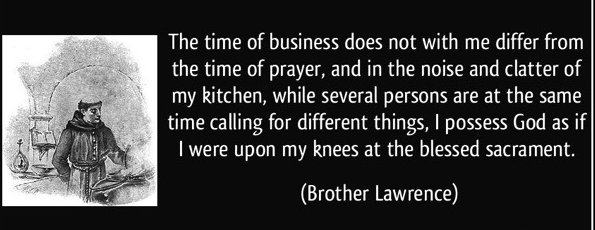
That spirit of joy in humble tasks was famously exemplified in a religious work from 17th century France called The Practice of the Presence of God, based on the life and words of a humble Carmelite lay brother known by the name Lawrence of the Resurrection, or simply Brother Lawrence. Lawrence served as a soldier during the 30 Years’ War. He was left permanently lame by his military service, and eventually found his way to a Carmelite monastery in Paris. He was rough, uneducated, and worked as the cook until gout forced him to even more humble work as a sandal maker. Yet people far and wide sought him out as a spiritual advisor for the peace and wisdom with which he performed even the simplest tasks.

One of his sayings, written down after his death, was this:

We ought not to be weary of doing little things for the love of God, who regards not the greatness of the work, but the love with which it is performed… We can do little things for God; I turn the cake that is frying on the pan for love of Him, and that done, if there is nothing else to call me, I prostrate myself in worship before Him, who has given me grace to work; afterwards I rise happier than a king. It is enough for me to pick up but a straw from the ground for the love of God.(2)

In other words—Be here now. Be willing to do the humble work of caring for others, of welcoming and feeding and sustaining community, but be fully present in it, offering all you do to God. Be both Martha and Mary. May all we do be done for the love of God, centered in the joy of helping each other in God’s name and to God’s glory.


Amen.


Preached at the 505 on Saturday, July 20, at St. Martin's Episcopal Church, Ellisville.

Readings:
Luke 10:38-42

Citations:
1) Ben Witherington III and Amy-Jill Levine, Luke:New Cambridge Bible Commentary
2) Brother Lawrence, The Practice of the Presence of God, downloadable for free at Project Gutenberg, http://www.gutenberg.org/ebooks/5657

Sunday, July 7, 2019

Going Joyfully into the Fields- Sermon for Proper 9, 4th Sunday after Pentecost


As I wrote in my priest’s reflection for July 4, the lectionary of the Episcopal Church treats Independence Day as a Holy Day in the Church’s calendar, and the gospel appointed for July 4 is Matthew 5:43-48, which implores those who follow Christ to emulate him, even to the point of loving our enemies and praying for them as much as we do for our neighbors. I spoke about how this dream for our country reflects back upon our baptismal covenant.

In our gospel today, we don’t hear about enemies and neighbors, but about wolves and lambs. We learn that it’s easy to be loving among lambs. To bear God’s love among wolves may be harder, but it is also what we are called to do to show that the kingdom of God is drawing near.

One common thread that ties the reading we heard tonight together is healing, and overcoming divisions and boundaries, just as that reading from Matthew implored us. Naaman may be a great general, but he is also afflicted by a stigmatizing disease. It is through a nobody—a captured servant girl from Israel—that he learns of a possible cure. No matter what, though, at the time we are talking about, however, the disease will progress, for it was incurable in those days—barring, of course, a miracle.

In those times, illness was isolating—and among certain people, such as Jews, touching someone or something unclean could make yourself outcast and unclean. Naaman is a man of power and influence, and he has probably tried everything he can think of already. How else to explain his listening to the advice of someone who normally would not attract his attention—as well as someone who is herself war spoils, and thus perhaps not be of the most kindly disposition toward Naaman. But for whatever reason, the unknown Israelite woman offers her master the possibility of help.


Even though we just met Elisha last week, here he is already a prophet of great renown. The King of Israel, when he receives Naaman, thinks he is being set up, and apparently has no knowledge of Elisha’s abilities in healing. Elisha, however, being a prophet, knows of the letter and reassures the king of Israel that this can be done. Elisha himself does not even meet Naaman, but sends a messenger to tell him what to do. This is seen by Naaman as a snub—he has travelled all this way, and this petty holy man won’t even meet him face to face? Naaman is also told to wash in some ridiculous little stream? He is outraged, but his servants with him point out that the cure before him is easy, so why not try it? Naaman is persuaded, and indeed, he is cured so that there is no sign he was ever a leper, if his skin becomes that of a “young boy.”

So, in a subtle way, Israel’s superiority—at least when it comes to her God and God’s prophets, is being asserted. Naaman may be able to conquer the Israelites, but they have something that he can never capture—a God who heals. All Naaman has to do is exhibit enough faith to complete the task set before him. Symbolically washing in Israel’s largest river is being willing to submit to Israel’s God. God’s gift to Naaman helps show that Israel’s God is great indeed, and, once again, a Gentile receives healing from the Israelite God, just as we have seen for the last several weeks.

It is also interesting to note that this foreigner is healed by immersing himself in the waters that traditionally are understood to divide Israel from her neighbors. What marks a boundary also mark the rupturing of the social boundaries between Gentile and Jew and between unclean leper and the rest of society. This story also emphasizes the barrier and boundary-defying power of God. God constantly calls us to break through artificial divisions and boundaries—physical, political, social, economic, religious. Far from being a tribal or national god, God’s message and salvific plan is universal.

This is a theme also emphasized in our gospel passage. Last week, Jesus warned his followers that they needed to be ready to sacrifice their old lives if they wanted to follow him. Jesus had just been rejected by a Samaritan village, and then he had told his followers they needed to be willing to lay down their lives for the sake of the gospel, as we talked about last week. Today we see Jesus commissioning the seventy (or seventy-two, depending upon the translation) followers to go out and help proclaim the Good News ahead of him as he has his “face set toward Jerusalem.” The number seventy is meant to portray the universality of the Good News referring back to the 70 nations descended from Noah’s sons after the Flood, listed in Genesis 10 as encompassing all of humanity. 

Just like in the story of Naaman’s healing, it is the nameless people who point the way to what God is doing in the world. The seventy are nameless just as the servants who advise Naaman are nameless. The implication of this is empowering: we don’t have to be spiritual gurus or haloed saints to do the work Jesus calls us to as disciples. Verse 1 makes it clear that Jesus is sending the 70 ahead of him “to places where he himself intended to go.” They are, to use the agricultural metaphor, preparing the field and planting the seed for when Jesus then comes later as “Lord of the harvest.” Because he has set his face toward Jerusalem, there is a sense of urgency—the time to plant the Good News is NOW. Yet just as the seventy returned with joy, so we too must begin and end not in fear, but in joy.

That same sense of urgency should drive us as Christians and as disciples and witnesses today. We live in a time today when church attendance is shrinking. Again and again, we talk about how we want the Church to grow—but gone are the days when we can sit back and wait for people to walk in our doors. 


Too many people see church doors themselves as barriers, not as entrances. We have to understand this-- we live in a time when people have been hurt by churches and self-professed Christians, hurt by being vilified for who they are or what they look like or who they love. We live in a time when clergy sexual abuse all across the spectrum has made people distrust the institutional Church, Catholic, Reformed, or Protestant—and rightly so. There are far too many people who call themselves Christians only as an act of exclusivity, as a justification for their putting down others and for building up those very barriers and boundaries that the power of God calls us to tear down in the name of the Gospel of Love and Peace.

That number 70 is a significant number for today, too. As of 2017, 72% of Episcopal congregations had an average Sunday attendance of 100 or less. This certainly sounds like bad news.

However, that also means we have an opportunity to reset the narrative, to see that the mission field begins right outside the doors of this parish, and out into our families, our neighborhoods, and our communities and our nation and beyond. It means also, however, that just like those seventy, we are called to go to where the people are who haven’t heard the good news.

There seems to be a church on every corner—if you are looking for them. Yet how many times have we heard that people don’t know where churches are—even if they drive by them every day? We have to learn that simply having a sign out front and a cross on the top of the roof isn’t enough. The seekers of today do not come looking for a church based on its marvelous signage. They look for a church that is engaged with the world, that seeks to make a difference in the community around it, that engages in mission that makes life meaningful and purposeful. 


They also need to be shown where the churches are-- that we are not a closed group with arcane rituals shut behind doors, but we are being the visible, living, loving Christ out in the world, meeting people and their needs where they are as Jesus did and does. They need to be specifically invited into our work in the world, and then welcomed and connected to the important visible work we do in the world, as well as our worship. To do that, we need to understand welcoming people differently-- as active, not passively waiting for people to come to us. As Bishop Mary Gray Reeves has noted, “Welcome precedes a sense of either believing or belonging.”

In what ways do we intentionally meet those who do not belong to the church, intentionally meet, get to know them and their stories, and not just invite them into community with us but declare our community with them? How do we attempt to emerge from behind our red doors and walls and become the Church in public spaces, open to encounter all comers?

It can seem daunting. Yet Jesus sent those seventy out not alone, but in pairs. He reminds them to be resilient: if you meet with rejection, shake the dust from your feet and move on—but never give up. As we talked about last week, we are not asked to engage in our life as disciples alone, but as a community. As a team.

Those seventy were accomplishing two main tasks on their journeys: to speak peace (shalom), and to demonstrate the kingdom of God coming near, turning everything upside down as it always does. They were called to demonstrate the kingdom through three activities in particular: they were teaching, they were preaching, and they were healing. And likewise we are called to the same tasks:

First, to speak peace. And not just speak peace, but embody peace and strive for peace and pursue peace, knowing all the while that the foundations of peace are justice and mercy intertwined. 

And then to make visible the coming near of God's kingdom. Our gospel lists three ways the 70 did that. Today, we teach and preach about Jesus to those who do not know him through how we live our lives, through testifying about the wondrous things God has done and is doing in our lives. Some saint famously said: “Preach the Gospel at all times. If necessary, use words.” We too can testify with our lives, and then use words as well.

We also must seek to heal the wounds that have been inflicted in people’s lives through a lack of care, empathy, and compassion. To seek to heal those wounds especially that have been inflicted by those who claim to be acting in the name of God. That can be done by something as simple as being present—being fully engaged and willing to listen to those who have been wounded.

God has empowered us—through our love in action, through our spirits and our bodies—to be healing forces in the world today, overcoming all that seeks to divide, to oppress, to wound. The way Jesus embodied God’s love in the world was by how he lived his life teaching, preaching, and healing, sometimes using words.

And how do we as the Church embody God’s love in the world? How do we shine a light on what God is doing in this neighborhood? How do we engage with the people around us so that they want to be a part of not just what we are, but what we are doing?

At our Anglican core, one of the most beautiful things we have going for us is our worship, and worship also is imbued throughout with hospitality and openness—God’s hospitality to us around the altar; our hospitality for each other in the Liturgy of the Word and Table. The point of hospitality is to break down barriers, not enforce them—and theologian Alan Roxburgh makes this point clearly when he says, “The primary way to know what God is up to in our world when the boundary markers seem to have been erased is by entering into the ordinary, everyday life of the neighborhoods and communities where we live.”

Once we do that, then we can invite the world to the table of God, where all boundaries fall, where all are welcome. It is at the table that we share the goodness of creation—bread and wine, offered and taken, blessed broken, and shared. Without any agenda but fellowship, and seeing the divine spark inside of everyone, even if it takes awhile.

The greatest gift Jesus gives us for this holy work, one that pushes back against the constant drumbeat of isolation and loneliness that pervades our society is the calling of us into community; in promising us companions and helpers along the way, in offering healing as much as empowering us to be healers as well.

May we go forth from here ready to live a life of love not just among lambs, but among the wolves, loving each and every person as God loves us, and inviting all to labor alongside us in the vineyard, where the harvest of hope and love is plentiful. This is our Gospel. May we go forth and proclaim it, in the healing name of God.

Amen.