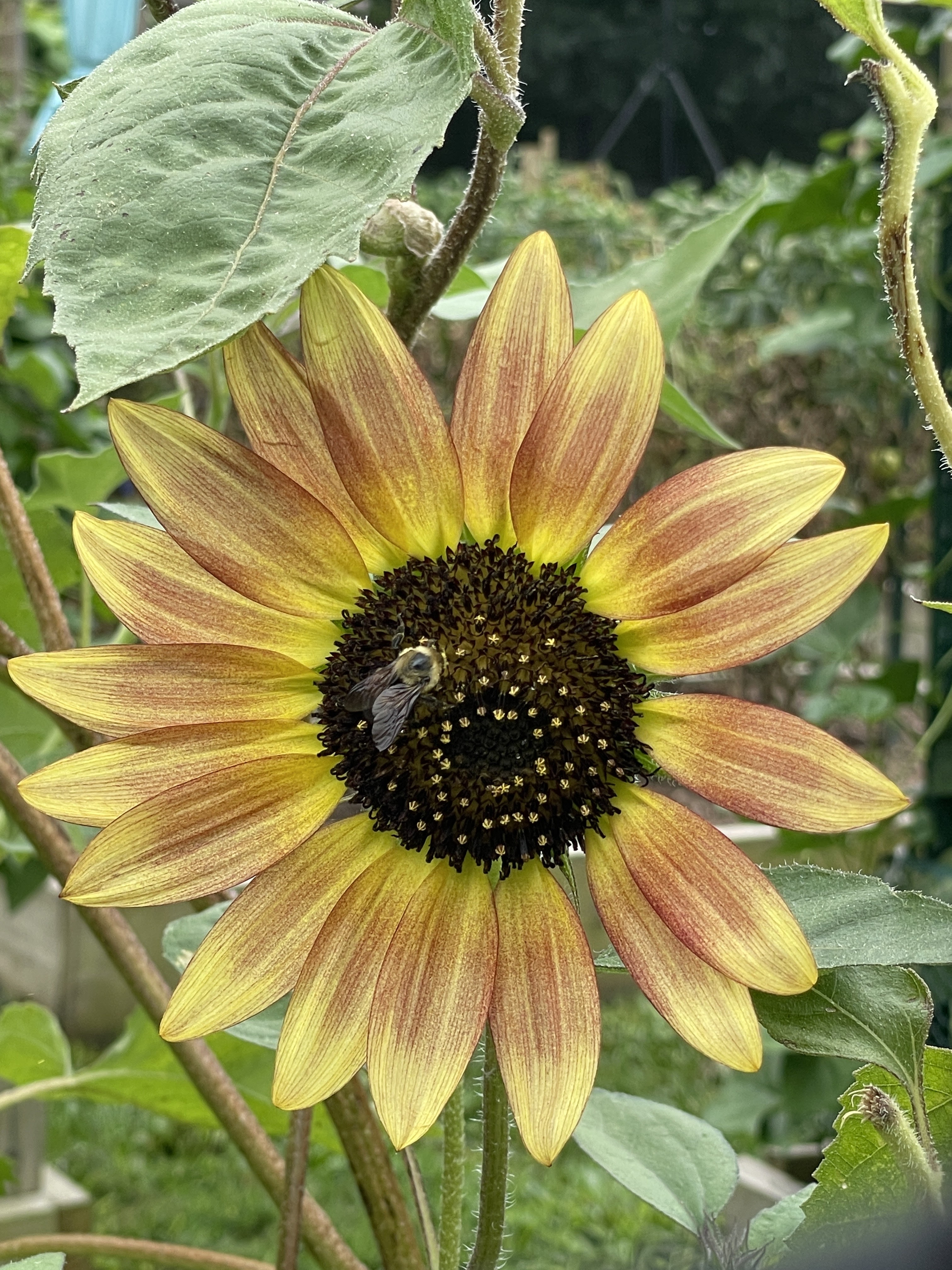
Showing posts with label creation. Show all posts

Sunday, October 6, 2024

Walking in Love With Creation: Sermon for the Feast of St. Francis of Assisi (transferred)


A long time ago, almost 800 years, there lived a man named Francis. He left behind family and wealth to become a repairer of churches, a deacon, and a friar who organized a new religious order based on humility and poverty in solidarity with the poor.

One day Francis was walking in the woods, traveling from one city to another as he recruited people to join his order. Above his head he heard hundreds of birds in the trees, singing and cheeping and doing all the bird-like things they could, with gusto. He heard in their joyfully noise a message of praise to God. The story goes that he called to the birds, and they flew down from the trees and gathered about his feet, and he began preaching to them:

“My little sisters, many are the bonds which unite us to God. And your duty is to praise Him everywhere and always, because He has let you free to fly wherever you will, and has given you a double and threefold covering and the beautiful plumage you wear.

“Praise Him likewise for the food He provides for you without your working for it, for the songs He has taught you, for your numbers that His blessing has multiplied, for your species which He preserved in the ark of olden times, and for the realm of the air He has reserved for you.

“God sustains you without your having to reap or sow. He gives you fountains and streams to drink from, mountains and hills in which to take refuge, and tall trees in which to build your nests. Although you do not know how to sew or spin, He gives to you and your little ones the clothing you need.

“How the Creator must love you to grant you such favors! So, my sister birds, do not be ungrateful, but continually praise God, who showers blessings upon you.”

It is said that the birds listened attentively, and that when he dismissed them to fly away they formed the shape of the cross in flight. He later joked that animals were more attentive congregations than many human ones he had encountered.

His love for creation as a testimony to the loving provision of God for all of us is something too many of us still have difficulty embracing. We live in a time when our planet is warning us about our lack of care for creation, whether through benign neglect or through outright exploitation of the Earth and her resources. As we look at the historic flooding caused by Hurricane Helene in places that had thought they were safe from climate change, and as we watch the formation of more, even stronger storms in the Gulf of Mexico and all around the world, some of us still view nature as an adversary to be conquered than a gift and revelation of God’s abiding love for us and for all God’s creatures.

This last week (on October 4, actually), it is our tradition to commemorate the Feast of St. Francis of Assisi, who is remembered as one who extolled the integrity, the oneness of creation, one who saw all of the universe, from the Sun and the Moon to even the tiniest creatures, as giving praise to the God and Creator of All. Our readings today reflect that spirit of the joyful honoring of creation that Francis taught.

Francis believed that creation revealed the glory and wisdom of God. There are stories of Francis moving earthworms aside so that he wouldn’t step on them, or of him saving a town that was being terrorized by a ravenous wolf by calling the wolf brother and treating it with such tenderness that it laid down at his feet and ravaged the town no more. No animals, from crickets and bees to falcons and pheasants, were too insignificant that Francis couldn’t see God’s generous love to us in the example of each creature.

In our gospel today, Jesus reminds us of the tender care he offers us, urging us to lay aside the striving of he world and lean into our trust in Jesus, whose burdens upon us are insignificant to the fears and anxieties of the world. In our passage from Psalm 121, we hear the voice of God reassuring us that God’s care and love for us never pauses, never ceases. And in our reading from Job, God lists wild animals not known in the ancient world for their wisdom and nonetheless asserts God's providential care. That generous, abundant provision is not just for domestic animals, as we humans sometimes emphasize, but on all creatures, especially wild beasts that roam free Jesus tenderly reminds us about the joy and beauty present in the most common things we tend to overlook in our distracted race through each day. In calling us to trust and awareness of all for which we could be grateful, Jesus calls us to live in each moment joyfully, bathed in God’s love.

Because it is so hard to fully live into each moment, we instead too often fall into the trap of feeling isolated from each other. That false sense of isolation leads to anxiety like Jesus was addressing, and that anxiety fools us into believing we are separate from one another. We see the effects of this belief right now in our city and throughout society. Anxiety and fear and isolation make us forget God’s promise of love and care.

Yet God’s promises to us are written into the very bonds of love that bind us to God, to each other, and to every living thing on the earth. That covenant that God established after the Great Flood was not just with Noah, but with both humans and all creation, plants and birds and all that lives, which, some scientists maintain, includes our very planet itself as a living organism, if one takes a broad enough view. The covenant story we heard from Genesis reminds us that creation is a full partner in our relationship with God, and gives God praise and glory.

Jesus reminds us that God’s love restores and renews us, so long as we center ourselves within each moment enough to feel that shared love. It is there in the joyful songs of birds whose welcome sings the morning into being. It is there in the lowliest, tiniest wildflower growing in a roadside ditch, turning its hopeful face toward the sun.

Instead of worry, Jesus calls us back to mindfulness, an important spiritual practice in many world religions. And not just any mindfulness, but the mindfulness of remembering how fully and thoroughly God loves us and through that love binds us together. Coming back to awareness of our unity with all living things is a wonderful place to start.

We see here in this anecdote that Jesus was a keen observer of the beauty of creation, and that he had spent time savoring the awareness of the birds singing and building their nests, and the sight of wildflowers—what some might call weeds—cloaking the fields and hills in beauty in a myriad of colors, all the hues of the rainbow mentioned in our first reading. Both the rainbow and the raiment of the most humble flower are signs to us of the promise God maintains with us and with all creation to love us and care for us always—not just in the distant past but right now and forever. Every living thing reminds us that God’s wondrous love bears the world into being and sustains it in every moment.

Luckily, we are also reminded of God’s love especially in the love and faithfulness of our companion animals, whose steadfast joy in us models to us the love and devotion we ourselves are made to exhibit toward our God.

At our pet blessing yesterday, those who gathered spoke of beloved canines and cats, fishes and rats—these creatures who show their devotion to us unswervingly. The very presence of all these living creatures in our lives remind us of God’s love. They remind us, also, that we are charged from the very first story in scripture with service to the earth and all the living things upon it and within it. Even the smallest creature has been placed on Earth to support the web of life on this planet, from humans to honeybees, and none is dispensable—not even wasps or mosquitos, who, I have to admit, are not my favorites. But we spoke of the ways that our pets’ devotion reminds us of the unswerving devotion and trust God’s abundant love elicits from us when we contemplate all the things for which we can be grateful in each day we live.

As we begin our stewardship campaign this year, I ask that you consider the way in which God has knit us into this huge community of creation, and consider the generous blessings of the natural world that make our lives possible. But I also ask that you remember how much the amazing community we have formed right here at St. Martin’s also finds ways to testify to God’s abundant love and grace each and every day, and ask each of you to recommit to supporting it

Our companion animals’ devotion exemplifies the devotion we owe God. Their love exemplifies the love we are called to bear for each other, no matter our differences.

St. Francis reminded us that all of creation participates in demonstrating God’s love—the same lesson Jesus taught us today in this gospel passage from Matthew. Each creature is a reminder of God’s blessing to and love for us. It is that holy and limitless love that binds all things together, just as mutual forces of gravity and attraction hold galaxies and stars in their courses as they dance through space. They walk alongside us as we seek to walk in love as Christ loved us, and gave himself up for us, a fragrant offering and sacrifice to God.


Amen.


Preached at St. Martin's Episcopal Church, Ellisville, MO on October 5-6, 2024.

 Readings:

Job 39:1-18

Psalm 121

Matthew 11:25-30


Image: "God's Fool," statue of St. Francis in Sts. Peter and Paul Cemetery, from Naperville, IL

Sunday, March 10, 2024

The World According to God: Sermon for Lent 4B


Today’s gospel brings to mind two distinct memories from my childhood. One is seeing somebody sitting in every end zone on Saturday and Sunday and Monday nights, holding up a sign that said simply “John 3:16.” 

I am sure it inspired many people to either nod their heads knowingly, or maybe to have enough curiosity to finds out what that sign referred to. Nowadays it would be as simple as pulling out your phone and using a search engine. But certainly some people looked up that verse, and were intrigued. Those that were destined to be Episcopalians would then look over the entire section of at least John 3:1-21, knowing that a few words—in this case 27 words—pulled out of an enormous book will lack a certain contextual depth and precision. Those are OUR PEOPLE!

Especially with this famous verse, context is vital. If you just stick with those 27 words, following Jesus is simply a matter of assent, a magical formula like abracadabra, a spiritual get-out-of-jail free card. But it’s not—assent is required, and commitment to not just saying some words, but living and loving like Jesus, who embodied God’s love in human likeness to be a model for our lives.

For many, this verse is a full and complete summary of the gospel. Martin Luther summarized this verse like this: “For the world has me; I am its God.”

But I think the next verse is just as important. “Indeed, God did not send the Son into the world to condemn the world, but in order that the world might be saved through him.”

God so loved the world, the world God made through speaking God’s wisdom into the world, that God sent God’s beloved Word to be incarnate—to take on human flesh to show us all how to be fully human and fully God’s children. Jesus is the embodiment of God’s wisdom in the world. Wisdom that can be lived in our own human lives-- if only we choose to follow.

That brings me to the second of my childhood memories, in the sweet little Methodist Church in which I was born and baptized, and that we attended until I was five. At Southern Hills Methodist Church, I remember singing this lovely hymn that so engaged my heart’s certainties, because it described the world according to God:


This is my Father's world, and to my listening ears
All nature sings, and round me rings the music of the spheres.
This is my Father's world: I rest me in the thought
Of rocks and trees, of skies and seas; His hand the wonders wrought.

This is my Father's world; the birds their carols raise,
The morning light, the lily white, declare their maker's praise.
This is my Father's world, He shines in all that's fair;
In the rustling grass I hear Him pass; He speaks to me everywhere.

This is my Father's world. O let me ne'er forget
That though the wrong seems oft so strong, God is the ruler yet.
This is my Father's world: why should my heart be sad?
The Lord is King; let the heavens ring! God reigns; let the earth be glad!
(1)

My own experience even as a very small child resonated so strongly with this hymn. Sharing the same sense of wonder and awe out in nature, delighting in the elephantine clouds slowly processing overhead down to the busy industry of ants moving among the moss on the north side of a tree, a tiny world humming with life beneath our feet, often too small to notice. I knew that God loves this world from clouds to ants to you and me, and made it a source of awe and wonder. I resolved never to lose that wonder—especially when things were hard. The signs of God’s love are shot through creation—and in our yearning hearts.

The message we hear in John’s gospel and in our Psalm is one of wonder and awe and gratitude, yes. But it is also a reminder that the Church goes astray when it puts limits on who God loves and who God does not. Our gospel also makes it clear that merely saying you believe in Jesus as a hedge against condemnation means nothing. Believing in Jesus means following Jesus in embodying that love into the world-- each of us.

Our first reading can lead us down a rabbit hole, with all its talk about God loosing poisonous snakes upon his maddeningly complaining people during the wanderings and discontent in the desert--unless we know the background behind it. The Priestly writers telling of this event is meant to support their belief that God smites and condemns those whose faith falters. Notice that Jesus does not repeat this belief in his referencing to that same event—he only talks about the cure. This aligns with his claim that God seeks always to save and redeem the world we have mangled through our own short-sightedness. Never to condemn it or all the living things who share this planet with us.

Last week we heard Jesus compare his body to the Temple, and we were reminded that God blessed and sanctified us in our bodies, too. In taking on our flesh, our human life, God continues to tear down the walls WE build to separate ourselves from God, and to remind us that God lives and loves within each of us right now, and through Jesus God keeps reaching over those walls and pulling us all over the top and never giving up on us.

In today’s readings, we hear about the blessings of light, of healing, and especially of love.

Light and darkness are important signs or symbols in John’s gospel, which makes sense, because they are important symbols to us. Our gospel today starts in the middle of Jesus’s conversation in the middle of the night, in the darkness, with a Pharisee named Nicodemus. Nicodemus comes in the night also because he lacks true understanding of who Jesus is, but at least he is straining toward the light.

When Nicodemus first approaches Jesus, in verses we don’t get to hear to help us understand the context, it is clear that Nicodemus is drawn to Jesus. Nicodemus is beginning to be drawn to the light of Christ, for at that start of chapter 3, he states: “Rabbi, we know that you are a teacher who is coming from God; for no one can do these signs that you do apart from the presence of God.” As a Pharisee and yet a seeker, Nicodemus is a man torn between two worlds, just as the church members in Ephesus were, and frankly much like many of us are.

Jest before our reading, Jesus tells Nicodemus he must be born again, which Nicodemus rightfully does not understand. Yet thinking about being born to a new life in Christ is a fruitful metaphor. We are born with an abiding hunger for connection, and for meaning even from the time we are infants. Babies want to be embraced, and they want to be fed. God helps this along by making babies helpless and also adorable, which goes a long way toward making up for the smell. With our poor eyesight, as infants we experience the world mostly through out hearts, and our bellies. Babies get anxious when either of these are not full—and I am persuaded that frankly, those feelings of hunger, especially spiritual hunger, remains one of the driving forces in our lives—one that we ignore or misuse at our peril.

Our own hunger for God within us brings us to this point, and calls us to repentance, to change. That change is scary. It means letting go of the familiar. But what will we gain? Only the certainty that we, and this whole world, are beloved by God.

How are our lives changed when we embrace Jesus as Savior? In our epistle, Paul states here that it is the difference between death… and life. We are asked to embrace our brokenness, and allow the light of Christ to wash over it. The world according to God is filled with reconciliation, discernment, self-honesty, and abundant beauty and grace. Paul’s words attest to the abundance of God’s love—abundant beyond our imagining, especially.

And here we see the blessing of healing that runs through all our readings, as well. Living as one of us, and dying as one of us, Christ in particular can reach into the shattered places in our spirits, and restore us from the shadow world in which we have lived into newness of life. Sometimes those wounds we bear were inflicted on us. Yet, other times, our own choices have wounded us. But God is always there.


Eternal life starts right now. It starts with understanding ourselves as living—right now-- in the presence of God. Right where we are. God loved us in this way, that God gave us God’s only Son. And why? So that NO ONE feels hungry, or empty, or lost—so that everyone can have a whole and lasting life. That Son didn’t come into the world to condemn us, but to save us, and remind us of who we are: Beloveds of a God who loves us and longs for us so much that God continually reaches out to us, asking us to align ourselves with God’s economy of abundance, grace, and peace.

The world according to God is one of grace, not condemnation. And as God’s Beloveds, we are called to bear God’s light into the world. The world that God so loves.


(1) Maltbie Davenport Babcock (1858-1901), American clergyman, poet, and hymn writer, “This is My Father’s World.” From the United Methodist Hymnal, 144.

Image: The famous "Big Blue Marble" photograph taken by the Apollo 17 crew on December 7, 1972 as the crew traveled toward the moon. This was the first photo of Earth that showed the southern polar ice cap. Image credit: NASA.

Readings:


Preached at St. Martin's Episcopal Church, Ellisville, on March 9-10, 2024, the Fourth Sunday in Lent.

Thursday, January 25, 2024

Prayer 4027: For Christian Unity


Creating God,
we rise beneath your spangled heavens,
the filigree of stars and constellations designed in your wisdom,
and we center ourselves in your love.

You weave together all that is
and charge and entrust us with serving and tending
this delicate, bountiful planet;
you knit together all peoples in one common tapestry;
the art of your creation fills us with wonder and awe.
You laid out a path of integrity and reconciliation
in the footprints of the Savior you send
to live among us and draw us closer to You.

All the works of your hand testify to your glory:
may the gravity and force of your Spirit
move over the deeps of our hearts
that we may stirred up to live by your precept of compassion.

May all who commit themselves to the Way of Jesus
live in amity and charity with each other,
and with all who seek to live lives worthy of You.

Gather into the vault of your mercy and compassion
all those who cry out to You, O Most High,
and give your angels charge
over those for whom we pray this day.

Amen.

Thursday, May 25, 2023

Home Among the Weeds: Speaking to the Soul May 25, 2023


At our former home
my beloved disliked
our Rose of Sharon trees—
he likened them to weeds.

Yet I am convinced
that it is always the “weeds”
that provide the most refuge
without asking anything in return.

In five minutes,
I watched six hummingbirds
zoom around the blossoms
as they jockeyed for a chance
at each unfurling blossom.

I watched cardinals
and Carolina wrens fight
over the ripening grape clusters
from the vine
that is supported by not one but two trees
along our fence.

I watched butterflies—
humble little skippers,
but also hairstreaks, fritillaries,
swallowtails,
and oh my God, even a monarch,
once so ubiquitous
but now almost as surprising to see
as a Bengal tiger.

Even on my deck I could hear
the thrum of probably thirty bumble bees
hovering like tugboats from blossom to bloom,
staying aloft
only God knows how.

We owe our lives
to the “weeds” of this world,
to their humble welcome
and hospitality,
anchoring the chain of life.

Is that not beautiful?


--This was first published at Episcopal Journal and Cafe's Speaking to the Soul on May 25, 2023.

Sunday, May 21, 2023

Created for Wonder: Sermon for the Feast of the Ascension (transferred)


There are a variety of images of the Ascension that have been visualized by artists throughout the centuries, and they range from straightforward illustrations from one of the readings we just heard, to the somewhat weird and then to the sublime. 

Icons are usually pretty straightforward: Disciples gathered around, Jesus rising to heaven, maybe a rainbow breaks out. Weird ones show just Jesus’s feet dangling in the top center of the picture, focusing on the comically awe-struck faces of the disciples. But the sublime ones express the mystery that is at the heart of the Ascension in a way that promoted thought and wonder.

One of my favorite images of the ascension of Christ is one by Salvador Dali, painted in 1958. It’s actually called Ascension: Pieta. This is not one of his stranger paintings with crutches and melted watches, or impossibly spindly, toothpick-legged horses or robotic humanoid figures.

This one is hyper-realistic. Christ is depicted floating directly over the viewer’s head, so you see bare feet, thighs, ribcage expanded like a diver getting ready to plunge, arms outstretched, hands powerfully flexed, straining and grasping at the air. Jesus’s chin is pointed skyward. The feet are smudged; Jesus’s time walking with the disciples is over.

But this diver is plunging upward, upward into the center of perhaps the nucleus of a cell, but more probably the center of an atom. See, this painting was inspired by a dream he’d had years before, soon after mankind first began creating atomic weapons. Dali depicts Jesus entering the nucleus of the atom, literally becoming one with all, part of the building block of the universe, which is actually a beautiful way of thinking about God using a scientific metaphor. 
Dali’s Christ turns thus bodily transforms a figure of destruction into a hope for new creation and unity. 

The "pieta" part of Dali's vision shows Dali’s wife Gala posing as the Jesus’s mother Mary, looking down on the world, weeping; knowing how her son has suffered and continues to struggle against the evil in the world. Yet even here the risen Christ, on his way to heaven, acts to unify with what we have used all our vanity and skill to break apart, offering to bring peace where we have unleashed destruction. Dali uses the Ascension to insist on the inherent unity of faith with science, and of Creator and creation, with Christ as the mediator.

Given that the Feast of the Ascension is about Jesus leaving his disciples and ascending to heaven, one might wonder, first of all, how this is something that should be celebrated, and whether anyone in their right minds can actually believe it happened at all. I can’t tell you how many times I have seen sarcastic pictures of Jesus dressed like an astronaut noting that, unless he obtained warp speed, even after 2,000 years he would still be zooming through the space in the Milky Way, our own galaxy.


The meaning and truth of the Ascension, or any biblical account, does not depend upon whether writers 2,000 years ago could describe what they experienced and witnessed with scientific precision. The Bible was never meant to be a scientific text—nor was it ever meant to be used to oppose or contradict science, reason, or knowledge. Whether in theology or in literature, great stories can expose deep truths about ourselves and our world even using fictional events and characters. The beauty of the Anglican strand of Christianity is that most of us are quite willing to imaginatively engage with both science and faith, and see them as complementary.

For instance, we no longer believe in a three-layered cosmos, with the Earth surrounded by waters and held up by pillars. And hopefully most of us have abandoned the idea that the Earth is flat too. Hopefully! 

We now know our galaxy alone has 50 galaxies within it, with maybe as many as 100 billion stars, most with their own systems, and that there are possibly 200 billion galaxies in the observable universe. That we know of right now. Where “heaven” is in relationship to all that is not a fruitful line of inquiry for most of us.

But that doesn’t mean that the Ascension is untrue. It is true in what it expresses—that Jesus lives, and is available to all of us and seeks out relationship with all of us that we may change the world. While in his earthly ministry, as a human he accepted certain limitations. He couldn’t be in two places at once, for instance, and so his ministry was limited to a small part of the world. Even in his resurrected body, he was still limited to this constraint until his ascent.

It's funny—we supposedly live in a scientific age, but most people’s actual knowledge of science, mine included, is not that great. Yet we use the tools of science to assault anything that threatens our own assumptions. We are now at the point when people simply block themselves off from information they don’t like—a perversion of not just the so called scientific revolution, but the tactic of tyrants and despots throughout history.

Yet God created us for wonder. And that’s part of what faith is all about.

So what might we take from the Ascension that would have meaning in our own lives? There’s enough there for a book (or many). It is about the uniting of creation with God, the completion of the unification of human with deity that began with Jesus’s entry into the world and continues after his return to God. It is the same mystery we celebrate every time we prayer together the Eucharistic prayer and unite ourselves with the ongoing heavenly banquet before God’s throne.

The Ascension is a mystery.

WHAT heaven is, and the kingdom of God is, is what Jesus came to us to reveal— and, as our scriptures today remind us for us then to reveal to the world. And he was clear that it was not a place as a state of existence beyond life and death. He was clear that it IS a state of existence that we could and do participate in, seeking it, working for it, NOW.

Heaven, the kingdom of God, is now—where peace, justice, equality, communion, compassion, generosity, abundance, grace, sacrifice, the common good, empathy—otherwise known as love in action-- reign. And we are called to help exemplify that and build that with our voices, our actions, our advocacy, our time, our choices, and our very lives.

And where Hell is now, where violence, injustice, oppression, hatred, contempt, deprivation, want, fear, selfishness, destruction, and cruelty—otherwise known as evil and sin, from individual to systemic-- reign. And we are called to resist that not just with “thoughts and prayers,” but with our voices, our actions, and our advocacy, our time, our choices, and our very lives.

That’s where Jesus’s Ascension comes in. The Ascension is the fulfillment of the Incarnation. In Jesus’s birth, God entered time and history. In the Resurrection, Jesus defeats death. In the Ascension, humanity is taken into the Godhead, for the Incarnate One sits at the right hand of God in his humanity and well as his divinity. Creation becomes one with Creator.

Jesus returns to God, the first resurrected one, completing the work in incarnation, in which humanity and creation become physically, truly one with God. Through Christ we are empowered by the Holy Spirit to witness to the Good News of God’s dream for us. Through Jesus’s Ascension, he is no longer rooted to any one place but becomes available to all as a living, loving presence in each of our lives. Through Jesus’s Ascension, the focus of Jesus’s followers moves from “What must we do to be saved?” to “What can we do to serve God and each other?” Inward to outward. From Jerusalem throughout the world.

Jesus’s leave-taking as necessary for us to continue to grow toward spiritual adulthood and fuller discipleship. Jesus promises he will NOT leave us orphaned, as we heard in our gospel reading last weekend; but he also commissions us to carry on his work in the world as both individual disciples and as a community known as the Church. Jesus honors us by placing the task of witnessing to him and his gospel in our hands.

We are not called by Jesus to stand looking up. We are called by Jesus to look around. To look around, to see the wounds of the world, wounds human hands have inflicted all too often and human silences have made worse. We are then called to look within, to look within our hearts and to the very atoms of our bodies and all creation, where Christ longs to dwell. To look within, and then around again, and see the wonder of the intricacies of creation, signposts of God’s love that is also embedded into the very atoms of this world.

The great 20th century poet and songwriter Bob Dylan underwent a religious conversion in the 1980s, and became a Christian. He wrote a song that combines this acknowledgement of the sinfulness and the beauty that is woven through our existence. It’s called "Every Grain of Sand:"

In the time of my confession, in the hour of my deepest need
When the pool of tears beneath my feet flood every newborn seed
There's a dying voice within me reaching out somewhere
Toiling in the danger and in the morals of despair

Don't have the inclination to look back on any mistake
Like Cain, I behold this chain of events that I must break
In the fury of the moment, I can see the master's hand
In every leaf that trembles, in every grain of sand

Oh, the flowers of indulgence and the weeds of yesteryear
Like criminals, they have choked the breath of conscience and good cheer
And the sun beat down upon the steps of time to light the way
To ease the pain of idleness and the memory of decay

I gaze into the doorway of temptation's angry flame
And every time I pass that way I always hear my name
Then onward in my journey, I come to understand
That every hair is numbered like every grain of sand

I have gone from rags to riches in the sorrow of the night
In the violence of a summer's dream, in the chill of a wintery light
In the bitter dance of loneliness fading into space
In the broken mirror of innocence on each forgotten face

I hear the ancient footsteps like the motion of the sea
Sometimes I turn, there's someone there, at times it's only me
I'm hanging in the balance of a perfect finished plan
Like every sparrow falling, like every grain of sand.
(1)


Yes, we can see the heartbreak of this world. But we can also see the wonder. Then go, empowered by love, and BE Christ’s own hands and heart to heal and reconcile. Because we know we are not alone.

The point is, we are not supposed to just stand there as Jesus ascends, gazing up at heaven, waiting for God to “do something.” We are commissioned to go do something—lots of things—ourselves in ministry to the world. We can do this because we know that God, Trinity and Unity all at once, is still with us within us, in every bone and sinew and atom, challenging us, inspiring us, urging us to practice resurrection in every thing we do.

Today, we celebrate the risen and ascended Christ, risen to his glorification so that he can intercede for ALL of us, risen, but never gone, never leaving us alone. And we can look around this creation that God tenderly created and continues to love and treasure, and be filled with wonder and awe. And then joyfully, filled with wonder, to take up Jesus’s call to witness, to reconcile, to heal, with every blessed, sacred atom of our beings.

Amen.


Preached at the 505 on May 20, and at the 8:00 and 10:30 am Holy Eucharists at St. Martin's Episcopal Church, Ellisville.

Readings:


Citations:
1) Bob Dylan, "Every Grain of Sand," from the album Shot of Love, 1981.


Monday, April 10, 2023

Easter Week


See the land, her Easter keeping,
Rises as her Maker rose.
Seeds, so long in darkness sleeping,
Burst at last from winter snows.
Earth with heaven above rejoices;
Fields and gardens hail the spring;
Shaughs and woodlands ring with voices,
While the wild birds build and sing. 

You, to whom your Maker granted
Powers to those sweet birds unknown,
Use the craft by God implanted;
Use the reason not your own.
Here, while heaven and earth rejoices,
Each his Easter tribute bring-
Work of fingers, chant of voices,
Like the birds who build and sing.


-- Charles Kingsley (1819-1875), English priest and poet

Sunday, April 9, 2023

Jesus the Gardener- Sermon for Easter A, April 9, 2023


You know, Easter is one of the few religious holidays that has crossed over into the secular calendar, even for folks that are not religious. Maybe that’s thanks to the candy companies, who’ve got tons of chocolate bunnies to sell and Cadbury Crème Eggs and let us, my friends never forget the visceral response those marshmallow-and-sugar-armored neon things called Peeps evoke in just about everyone. Seriously, love them or find them revolting. No middle ground there. Easter in many people’s minds is all about the pastel colors, tulips and lilies, the Easter Bunny, and maybe a new outfit or a new hat, and about gathering family around Easter dinner.

Speaking of food, around which ALL great American holidays orbit, if you try to go out to eat today, good luck, by the way—Easter brunch smorgasbords are a huge money-maker for restaurants. As long as you already have reservations, that is. I’m too wiped out for that kind of death match at the prime rib station, myself. I would probably fall asleep in my twice-whipped potatoes.

We’ve been seeing plastic Easter eggs and Easter candy in the candy aisle in the drug store for 7 weeks now—it came out just as soon as the Valentine’s candy was reduced to half off on February 15. And tomorrow, it will all be gone. The candy makers will have to wait until Labor Day to put up their Halloween displays. People will resume their lives as if Easter is over.

But it is not. For Christians in liturgical traditions such as ours know that Easter is a season—lasting during the Great 50 Days until Pentecost. But there’s a secret: when you examine what we really believe in the Episcopal Church, Easter is not just a season. It is an ongoing, ever-present reality.

Following in the teaching of the great scholar St. Augustine, we are an Easter people in the Episcopal Church. One Easter Sunday long ago, he preached “We are an Easter people, and Alleluia is our hymn of praise!”

Being an Easter People means, first of all, being a people of resurrection. We are a people who know that eternal life begins right here, right now, in living a life of faith and discipleship. We do not simply await the resurrection of the dead that some people fixate on. We are called to resurrection because resurrection is about LIFE, not what happens to us when we die. Contrary to what some goateed, head-bobbing TV preachers say, Jesus did not simply die for us to take away our sins. Jesus rose victorious from the grave to remind us that we are a new creation in Christ. Being an Easter people means LIVING out our faith in Jesus as our Savior by imitating him. That’s why we are ever hearing scripture through new ears and seeing it through new lenses. Jesus’s redeeming work in the world is not confined to the stories and verses in the Bible. Jesus is alive and asks to reign in our hearts and lives right now. God is still speaking to us right now. The Holy Spirit is still moving right now.

And we need that presence more than ever, regardless of what newspapers say about the death of the Church. Because we are an Easter people—living in a Good Friday world, as the writer Anne Lamott famously noted, quoting Barbara Johnson
(1). She wrote those words at a time of the Iraq War, and she was despairing over all the crises that loomed over us just like crises that loom over us now. And so she sought comfort in simple things.

She wrote: “I am going to try to pay attention to the spring, and look up at the hectic trees. Amid the smashing and crashing and terrible silences, the trees are in blossom, and it’s soft and warm and bright. I am going to close my eyes and listen. During the children’s sermon last Sunday, the pastor asked the kids to close their eyes for a moment—to give themselves a time-out—and then asked them what they had heard. They heard birds, and radios, dogs barking, cars, and one boy said, “I hear the water at the edge of things.” I am going to listen for the water at the edge of things today”
(2).

Those words resonated with me, tree-hugger that I am. And they resonate with the Easter message we Easter people just heard a few moments ago.

Anglican biblical scholar, and bishop N. T. Wright is clear: Easter Day is not the happy ending to the long dreary Lenten slog of Jesus’s rejection, trial, lingering execution and death. No, he says, “Easter is the start of something. It isn’t the ending. It is the beginning of the new creation which has been made possible by the overcoming of the forces of corruption and decay in the death of Jesus…. In the New Testament we find a very different picture. We do not find a ‘life after death’ in heaven, but a ‘life after “life after death”’, a newly embodied life in a newly reconstituted creation. And we see Jesus’ resurrection, not as the ‘happy ending’ after the crucifixion – though to be sure it functions like that at a fairly trivial level – but as the launching of nothing less than new creation itself
(3)."

Perhaps that is why I want to direct your attention back to a detail in our gospel passage we just heard. Mary Magdalene approaches the tomb early that morning. She is still in that Good Friday world—the main reason you approach a tomb is to remember the person who is gone. But when she gets there, she finds the tomb empty. Hoe much more must that have devastated her—she has lost her beloved friend and teacher, and now she doesn’t even have the closure of knowing where his body is. She runs to tell the male apostles, and then she returns, weeping. It is there that she is confronted by two angels, who ask her why she is crying. As she is answering, she turns around and sees Jesus. But she doesn’t recognize him. Instead, she thinks he is the gardener.


Lavinia Kunstdruck, Noli Me Tangere, 1581
People throughout the ages have wondered WHY her mind immediately jumped to the category “gardener” when she saw Jesus. I mean, there’s a little bit of comic relief provided here in what is otherwise a heart-breaking scene, even if you know how it’s going to turn to joy in about two minutes, as we do.

Mary Magdalene’s confusion has been a rich source for artists and poets throughout the ages. Seriously-- type “Jesus as gardener” into google images, and you will probably be stunned at all the ways this scene is represented. Some just show Jesus and Mary Magdalene in a lush landscape. Other artists go all in, and depict Jesus holding a spade or a hoe, and some, like Rembrandt, even show him wearing a floppy hat. 

Michael Cook, Noli Me Tangere, from A Derbyshire Passion Stations of the Cross, Derby Cathedral, 2016

Janpeter Muilwijk, New Gardener, 2017

Some have tried to find a practical explanation for Mary’s confusion. After all, Jesus has shed his burial clothes and his other clothes were stripped from him and divvied up when people gambled for them, so maybe he borrowed the gardeners spare pare of gardening clothes so he wouldn’t be strolling around in his altogether. Modern versions even sometimes show him in overalls.

The painting on our bulletin cover is one of the most recent versions I could find, painted in the midst of the pandemic in 2021 by Joel Briggs. In his version, we don’t see Mary Magdalene, but we see Jesus with a shiny shovel over his right shoulder, standing in a denuded swamp, trees stripped bare and snapped off as if an F5 tornado had just barreled through. And yet, look over Jesus’s shoulder and there in the cerulean sky is a rainbow. A dove perches on the shovel handle, with an olive branch in its mouth. And Jesus holds a seedling in his left hand, where a king holds the orb that is a sign of his power over the entire earth. The wounds of his crucifixion are visible on his wrist and his side. Off in the distance at his elbow there is rain from the thunderheads on the horizon.

As observers standing in front of Jesus in the midst of a wrecked landscape, both physical and spiritual, wrecked by our own actions and inactions, we hear echoes not just of the destruction of Good Friday but also of the story of the loss of the Garden of Eden, of Noah’s ark coming to rest on the sodden earth after the flood waters have receded. We would be fools if we do not also see a warning about rising sea levels and our changing climate, of polar ice thinning and disappearing and weather becoming ever more extreme with each passing month that we do nothing.

Yet, this gardener Jesus looks forward confidently, ready to start anew—and expecting US to help him. This is not the false version of God, the Santa-Claus-God, The Wish-Fulfilling-Genie -God that waves a magic wand and fixes things for us that we don’t want to do ourselves. This is the God who rolls up their sleeves and reminds us that we were created in God’s image to share in God’s work of healing and compassion, most of all.

Perhaps, Mary Magdalene sees Jesus as a gardener because that is exactly what he is. The Risen Jesus is, and always has been, the messenger and inaugurator of a new creation, a return to the garden. And the first garden he asks to tend and care for is right inside of us—right here in our own hearts. The love of God that Jesus teaches us is the fertile soil in our hearts that Christ can bring to bloom—if we welcome him in. And then we can begin the work of reconciliation and healing of this world. Rather than Jesus’s death and resurrection leading us as his followers to a rejection of this world in favor of simply waiting it out until we go to heaven, the risen Christ reminds us that eternal life is NOW, not later.

Wlodzimierz Kohut, Jesus the Good Gardener, 2015

The poet Andrew Hudgins imagines this scene in his poem “Christ as a Gardener:”

The boxwoods planted in the park spell LIVE.
I never noticed it until they died.
Before, the entwined green had smudged the word
unreadable. And when they take their own advice
again – come spring, come Easter – no one will know
a word is buried in the leaves. I love the way
that Mary thought her resurrected Lord
a gardener. It wasn’t just the broad-brimmed hat
and muddy robe that fooled her: he was that changed.
He looks across the unturned field, the riot
Of unscythed grass, the smattering of wildflowers.
Before he can stop himself, he’s on his knees.
He roots up stubborn weeds, pinches the suckers,
deciding order here – what lives, what dies,
and how. But it goes deeper even than that.
His hands burn and his bare feet smolder. He longs
To lie down inside the long, dew-moist furrows
and press his pierced side and his broken forehead
into the dirt. But he’s already done it –
passed through one death and out the other side.
He laughs. He kicks his bright spade in the earth
and turns it over. Spring flashes by, then harvest.
Beneath his feet, seeds dance into the air.
They rise, and he, not noticing, ascends
on midair steppingstones of dandelion,
of milkweed, thistle, cattail, and goldenrod.
(4)

A garden is a place of care, of craft, of ongoing cycles of life and greening and renewal. It is a place where resurrection is practiced daily, a collaboration between human and earth that reminds us of the blessing of life and abundance that is the heart of God’s dream for us. Resurrection is not an event, it is a way of true life. In the garden, we remember the words of Henry David Thoreau, heaven is beneath our feet. Heaven is not “God’s space” and the Earth “our space.”
(5) Jesus told us repeatedly that the kingdom of God—heaven—is right here, right now, among those who are an Easter people, a people who believe in the power of resurrection against the powers that tell us we are helpless to keep us from rising up and demanding true justice, grace, and mercy to reign instead.

The Romans treated Jesus and all those whom it executed and oppressed as disposable, and such is the way of all tyrants even in our own time. The world we inhabit right now has a tendency to do the same to both people and this planet and everything on it. The heart of Jesus’s message is exactly the opposite-- that no one and no thing are disposable. God has renewed creation in Christ—and ever calls us to be partners in God’s holy work of restoration, reconciliation, and healing. That is the heart of Jesus’s good news from the time of his birth through his passion and resurrection, through his calling to us today.

Jesus’s resurrection is ours too. We have been placed in a garden—the only place in the entire universe that we are sure can support us and our children and all the other living things that are so gloriously and wondrously made. Jesus calls us to die to short-term thinking and instead embrace the power of resurrection in our relationship with God, with each other, and with this beautiful planet which God ever calls “good.” All these relationships call out for us to commit to a not just a season but a lifetime committed to revival, to living out the power of resurrection. For now. For good.

Our loving gardener, Jesus Christ, has planted us, tended us, and cares for us with tenderness. Let us renew our commitment to be an Easter people, resurrected, blooming and beautifying the places we are planted, and alive with new growth. Alleluia! Christ is risen! Let us rise with him, and get to work restoring the garden.


Amen.


Preached at the 10:30 am Holy Eucharist on the Day of Resurrection, April 9, 2023, at St. Martin's Episcopal Church, Ellisville, MO.

Readings:

Citations:
1) Anne Lamott, Plan B: Further Thoughts on Faith, 140. Kindle edition.
2) Lamott, Plan B, 144.
3) N. T. Wright, “Resurrection and the Renewal of Creation,” lecture at Baylor University, Nov. 16, 2018), available here as a pdf or also available on YouTube here.
4) Andrew Hudgins, from The Never-Ending, 1991.
5) Wright, "Resurrection," see above.


Thursday, December 1, 2022

Praise Now: Speaking to the Soul, December 1, 2022


Inspired by Caedmon’s Hymn

O God the Maker, whose creation brings forth stuttering praises of awe and wonder
from the untutored tongues of your children,
our hearts overflow now with your marvelous love.

Holy One, you weave the silken tapestry of heaven,
glorious to drink in and refresh our faith,
spread overhead like the canopy of a mighty oak
drawn anew to contemplate the depth of your wisdom.

Our feet firmly planted among the grasses,
our eyes lifted to the spangled expanse
of the roof of the world You have made, World-Warden;
we stretch heavenward like tender saplings.

You have fashioned this Earth as our home,
and made it holy by the work of your fingers
for all to rejoice in your bounty.

Gratitude and wonder are the foundation of our prayer,
surging up like a spring of water from our souls.

And now, O Creator,
gather our swirling thoughts
within the bounds of your mercy,
and grant your blessing upon us,
and all who turn their hearts to your light.

Amen.


This was first published at Episcopal Journal and Cafe's Speaking to the Soul, December 1, 2022.

Thursday, November 10, 2022

Benedicite Missouri: Speaking to the Soul, November 10, 2022


All praise and blessing to our Creator,
   who tenderly shapes and sustains us:
O praise and glorify our God
   whose love tenderly nourishes us forever!

You constellations, meteor showers, and galaxies; sun and moon and clouds,
Sparkling Milky Way dancing overhead in velvet night:
give to your Creator your thanks and praise.

Father of Waters, rivers and streams, prairie, glade, and grassland,
Wetlands and forest, karst and cavern, limestone and chert:
give to your Creator your thanks and praise.

Shortleaf pine, pawpaw and hickory, canoe birch and cypress,
Redbud and dogwood blazing pink and white in spring joy:
give to your Creator your thanks and praise.

Sweet flag and cranesbill; brittle and crested shield ferns,
Dogtooth and birdsfoot violets carpeting the ground in beauty:
give to your Creator your thanks and praise.

Big Bluestem, foxglove and bluebells nodding in wind-kissed woods,
Little star moss, chantarelles and morels hidden like treasure underfoot:
give to your Creator your thanks and praise.

Sapsuckers and screech owls, kestrels and turkey vultures tracing the sky,
Waxwings in cedars, indigo buntings flashing electric blue:
give to your Creator your thanks and praise.

Swallowtails and monarchs, tiger moths and sulphurs warming your wings in sunlight,
Commas and fritillaries nectaring in coneflower fields, bats wheeling at dusk:
give to your Creator your thanks and praise.

Crayfish and mussel; painted mudbug, hellbender and harlequin darter shyly hiding,
Bluegill and bowfin; mudpuppy and milksnake; spring peeper and bullfrog dueting:
give to your Creator your thanks and praise.

Bobcat and coyote; mink, muskrat, and red-eared slider in sheltering riverbank,
Red fox and opossum, white-tailed deer leaping ravines:
give to your Creator your thanks and praise.

Children of the Middle Waters, Illiniwek, O-Gah-Pah, Jiwere, and Nutachi,
Farmers and businesspeople; parents and children; kindred united in this beautiful land
give to your Creator your thanks and praise.

Let all who breathe and live and turn their faces to the sun bless our Creator,
   Whose wisdom weaves us together as one family,
Joined together in mutual gratitude and sustenance:
   O praise and glorify our God
   whose love tenderly nourishes us forever!


This was first published at Episcopal Journal and Cafe's Speaking to the Soul, November 10, 2022.

Thursday, September 8, 2022

The Way Prayer Rises: Speaking to the Soul for September 8, 2022


The way the air holds warmth 

like a brimming teacup, tenderly
lifting the turkey vultures so high
their grace is all you see, as they trace
lazy lemniscates 
                     forever,
                           forever,
                               forever,
balancing on a thermal delicately,
black-winged angels gravely waltzing 
           atop the head of a pin

The way the painted sunflower bows
her head under the weight of the bumblebee
and the tickseed heads bristle with hyphenated seeds
that will scatter their blessings over 
the living earth
     and prepare a table before the goldfinch
        in the presence of those who treasure her

The way September’s grasshopper
rasps his way from ditches to gravel roads
his battered wings extolling his travels even as
newborn monarchs iron their wings
     under a radiant, dog-summer sun
          and shadows with edges like knives

The way the redbud leaves dance–
a line in the canopy shifting green to citrine
affirming the beauty of repair, healing, and resilience
like a vein of gold repairing a broken pot
      made more beautiful
            for the continued life it offers

is the way prayer rises and falls


-- This was first published at Episcopal Journal's Speaking to the Soul on September 8, 2022.

Thursday, September 1, 2022

Praise Song at Dawn: Speaking to the Soul for September 1, 2022


Loving Creator,
we rise from our rest to sing your praise,
joining the world You have made holy
through your hands, O God.

The coyotes are back in their dens,
after antagonizing the farm dogs all night;
the barred owls have paused their conversation
under the lacy veil of heaven at sun rise;
katydid, tree frog, and cricket have raised their song
and filled the night with the throb of their praise:
now it is time for us to lift our hearts
and join in the love song of the Earth for our Maker.

Almighty One, this moment is your gift to us, too:
let us use it to center ourselves in your grace.
Let us in our prayer give thanks
for all your blessings to us,
especially this fragile Earth:
may we seek to mend and heal
the frayed cords that bind us to all creation,
and see with new eyes the beauty and completeness
in a drop of rain or sparkle of dew.

The Earth beneath our feet
is your gift to all that lives,
to animal, tree, and stream: all creation is holy.
May we care for each other with tenderness and unity,
walking in the healing path that Jesus invites us to follow.
Tune our hearts to always hear
the echo of our Savior’s laughter and empathy
through the air that still carries the imprint
of his breath and blessing.

Spirit of the Living God,
spread your wings over us
that we may be strengthened to joyfully greet this day,
and grant your peace to all for whom we pray.

Amen.


-- Leslie Barnes Scoopmire. This was first published at Episcopal Journal's Speaking to the Soul on September 1, 2022.

Thursday, August 18, 2022

The Gardener Asks for Wonder: Speaking to the Soul, August 18, 2022


“Never once in my life did I ask God 
for success or wisdom or power or fame.
I asked for wonder, 

and he gave it to me.” – Abraham Joshua Heschel


Knee-deep in a prie-dieu of compost,
I asked for wonder,
and pledged my attention,
hoping to lose
thought of myself
in the prayer of planting (for
both are acts of hope)—

seedlings sliding like prayer beads
through my hands what was once
a ditch-side rogue’s gallery elevated
to rockstar status in repair of the Earth:
Joe Pye weed, bergamot, Indian
blanket, rue, aster, true blue
wild indigo, lead plant, blazing star,
columbine, Queen Anne’s lace, 
even lowly clover and thistle.
Turn, turn, turn; the time to pluck up is gone;
the time to plant our purpose under heaven.

To feel the thrum of life beneath my feet,
human rooted in humus
as in the beginning--
almost like stumbling across
God perambulating in an evening garden
leaving behind dewy footprints fresh from bestriding
the sea, pacing off its measure in refutation of Job;

To hear the ethereal
music of hillside pine needle overhead
propelled by wind, the choir 
of hummingbird and song sparrow bobbing
on risers of redbud to the overture of offstage thunder.

But now it has
come down to this:

God answers through
a single brave
monarch butterfly
fluttering by, the first
of the season (enticed by
suburban crewcut

lawns surrendered
and sacrificed as altars 
to milkweed), and by the once-
quotidian honeybee delicately
and now heroically paying homage,
sending salvations of salvia and soybeans nodding, merely
feeding a planet…

and we rejoice at the sight, remembering
when we fools thought them 
common
as a comma.

Here is our hope on the wing.


--This was first published at Episcopal Journal's Speaking to the Soul on August 18, 2022.

Thursday, August 11, 2022

Forest Sonnet, Whidbey Island: Speaking to the Soul for August 11, 2022


(For a friend in grief,
for the assurance of resurrection )


Now, no matter, child, the name:
Sorrow's springs are the same.
No mouth had, no nor mind, expressed
What heart heard of, ghost guessed:
It is the blight man was born for,
It is Margaret you mourn for."

     --from “Spring and Fall,” by Gerard Manley Hopkins


Here Sorrow springs and newborn Spring sorrows;
Their grief resolves in fiddleheads tomorrow.
The mournful poet sees the greening leaf
and vaults ahead to autumn's parting grief....

An anticipatory grief, so-called.
Here last year's leaves lie trodden, branch scraped-bald
From winter's remnant grip. But see, as Spring
Flushes first rosy throat, as thrushes sing

God's glory! Still, larks chirruping, skimming
The winds arise from southern vales, brimming
Their blessings upon the restive, waking Earth.
The forest floor will testify that birth

Sings from subsidence, converting death
God's gravid Spirit-- resurrection's breath.


--This was first published at Episcopal Journal's Speaking to the Soul on August 11, 2022.

Monday, March 21, 2022

Prayer 3334: On the First Full Day of Spring


O God,
as Earth turns in wakefulness
from the slumber of winter
to the rising dawn of spring,
as geese arrow southward overhead,
we too turn our thoughts to home,
the sunlit home we offer us in your kingdom.

Help us gather
beneath your shining countenance.
Help us sing out your love;
let halting harmonies
become intricate tapestries of grateful praise,
for your love is steadfast and true.

May we release the stones of our cares
in the deep well of your abundant grace,
casting all our burdens
upon the promise of your mercy and care.
Teach us to walk in paths of compassion
to share from the bounty we have received
of charity, forgiveness, and holy wisdom.

O God,
cast your finest net beneath our seeking hearts
that we may be gathered when our way turns to wandering
as we long to be drawn
within the sheltering wing of your loving-kindness,
and extend your sheltering hand
beneath those for whom we pray.

Amen.